

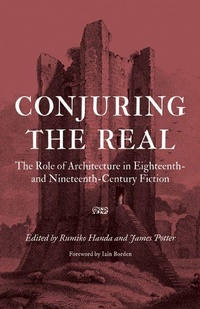
Conjuring the Real
The Role of Architecture in Eighteenth- and Nineteenth-Century Fiction
Published on 1. June 2011
Book
Paperback/Softback
232 pages
978-0-8032-1743-0 (ISBN)
Description
In the Western world the period from the mid-eighteenth through the nineteenth century was a time of expanding historical consciousness, a period that saw the birth of modern historiography, a profusion of historical novels and paintings, and the widespread production of historical plays. Historical buildings, in themselves already of intense interest to people of the day, also found their way into the multiplying cultural forms as concrete presences anchoring a novelist's, poet's, painter's, or, eventually, filmmaker's vision of the past. In recent years a number of blockbuster films have used historically significant buildings as filming locations because buildings can concretely bring a former era or fictional world closer to contemporary viewers. Conjuring the Real traces the genealogy of this representational role of architecture, going back through the history of film and then further in literature, art, and theater. The contributors examine the ways in which authors, artists, and stage managers used complex depictions of buildings to feed and shape the audience's historical imagination. How can we understand the significance of architecture, not through its original design and construction but through the ways in which the public experiences, perceives, and understands it? The contributors pursue this question through the ideas of secondary portrayers of historical buildings, such as writers and artists, and then through the responses of those who read and view these creations.
More details
Language
English
Place of publication
Lincoln
United States
Target group
Professional and scholarly
Product notice
Paperback (trade)
Illustrations
33 illustrations
Dimensions
Height: 213 mm
Width: 140 mm
Thickness: 18 mm
Weight
318 gr
ISBN-13
978-0-8032-1743-0 (9780803217430)
Copyright in bibliographic data and cover images is held by Nielsen Book Services Limited or by the publishers or by their respective licensors: all rights reserved.
Schweitzer Classification
Persons
Rumiko Handa is a professor of architecture at the University of Nebraska-Lincoln. James Potter is a professor emeritus of architecture at the University of Nebraska-Lincoln. Iain Borden is a professor of architecture and urban culture at University College London and the author or editor of several books, including The Unknown City: Contesting Architecture and Social Space. Contributors: Michael Alexander, Andrew Ballantyne, Stephen Bann, Iain Borden, Ian Christie, Rumiko Handa, Toby D. Olsen, Richard Schoch, and Josh Silvers.
Content
List of Illustrations
Foreword
Iain Borden
Introduction
Rumiko Handa
1. "All That Life Can Afford"? Perspectives on the Screening of Historic Literary London
Ian Christie
2. Architecture in Historical Fiction: A Historical and Comparative Study
Michael Alexander
3. Norman Abbey as Romantic Mise-en-Scene: St. Georges de Boscherville in Historical Representation
Stephen Bann
4. Performing History on the Victorian Stage
Richard Schoch
5. Shops and Subjects
Andrew Ballantyne
6. Pride and Prejudice: Establishing Historical Connections among the Arts
Josh Silvers and Toby D. Olsen
Contributors
Foreword
Iain Borden
Introduction
Rumiko Handa
1. "All That Life Can Afford"? Perspectives on the Screening of Historic Literary London
Ian Christie
2. Architecture in Historical Fiction: A Historical and Comparative Study
Michael Alexander
3. Norman Abbey as Romantic Mise-en-Scene: St. Georges de Boscherville in Historical Representation
Stephen Bann
4. Performing History on the Victorian Stage
Richard Schoch
5. Shops and Subjects
Andrew Ballantyne
6. Pride and Prejudice: Establishing Historical Connections among the Arts
Josh Silvers and Toby D. Olsen
Contributors