

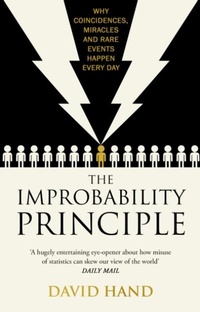
The Improbability Principle
Why coincidences, miracles and rare events happen all the time
Published on 29. January 2015
Book
Paperback/Softback
320 pages
978-0-552-17019-2 (ISBN)
Description
Why is it that incredibly unlikely phenomena actually happen quite regularly and why should we, in fact, expect such things to happen? Here, in this highly original book - aimed squarely at anyone with an interest in coincidences, probability or gambling - eminent statistician David Hand answers this question by weaving together various strands of probability into a unified explanation, which he calls the improbability principle.
This is a book that will appeal not only to those who love stories about startling coincidences and extraordinarily rare events, but also to those who are interested in how a single bold idea links areas as diverse as gambling, the weather, airline disasters and creative writing as well as the origin of life and even the universe. The Improbability Principle will change your perspective on how the world works - and tell you what the Bible code and Shakespeare have in common, how to win the lottery, why Apple's song shuffling was made less random to seem more random. Oh and why lightning does in fact strike twice...
This is a book that will appeal not only to those who love stories about startling coincidences and extraordinarily rare events, but also to those who are interested in how a single bold idea links areas as diverse as gambling, the weather, airline disasters and creative writing as well as the origin of life and even the universe. The Improbability Principle will change your perspective on how the world works - and tell you what the Bible code and Shakespeare have in common, how to win the lottery, why Apple's song shuffling was made less random to seem more random. Oh and why lightning does in fact strike twice...
Reviews / Votes
A hugely entertaining eye-opener about how misuse of statistics can skew our view of the world * Daily Mail * Lively and lucid . . . an intensely useful (as well as a remarkably entertaining) book . . . * Salon * In my experience, it is very rare to find a book that is both erudite and entertaining. Yet The Improbability Principle is such a book. Surely this cannot be due to chance alone! -- Hal Varian, Google's Chief Economist An elegant, astoundingly clear and enjoyable combination of subtle statistical thinking and real-world events. -- Andrew Dilnot, co-author of 'The Numbers Game' As someone who happened to meet his future wife on a plane, on an airline he rarely used, I wholeheartedly endorse David Hand's fascinating guide to improbability, a subject which affects the lives of all, yet until now has lacked a coherent exposition of its underlying principles. -- Gordon Woo, catastrophist at Risk Management SolutionsMore details
Language
English
Place of publication
London
United Kingdom
Publishing group
Transworld Publishers Ltd
Target group
College/higher education
Professional and scholarly
Product notice
Paperback (UK-B)
Dimensions
Height: 198 mm
Width: 126 mm
Thickness: 25 mm
Weight
232 gr
ISBN-13
978-0-552-17019-2 (9780552170192)
Copyright in bibliographic data and cover images is held by Nielsen Book Services Limited or by the publishers or by their respective licensors: all rights reserved.
Schweitzer Classification
Other editions
Additional editions
David Hand
The Improbability Principle
Why coincidences, miracles and rare events happen all the time
E-Book
02/2014
1st Edition
Transworld Digital
€9.99
Available for download
Person
DAVID HAND is an emeritus professor of mathematics and senior research investigator at Imperial College, London, a former president of the Royal Statistical Society and chief scientific advisor to Winton Capital, Europe's most successful algorithmic trading hedge fund. He is the author of seven books including two popular titles (The Information Generation: How Data Rule Our World (Oneworld, 2006) and Statistics: A Very Short Introduction (Oxford University Press, 2008)). He is also the coauthor or editor/coeditor of several other academic titles, has published some 300 scientific papers and written popular articles for publications ranging from Mathematics Today to the Guardian.