

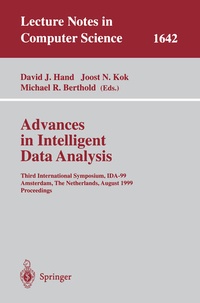
Advances in Intelligent Data Analysis
Third International Symposium, IDA-99 Amsterdam, The Netherlands, August 9-11, 1999 Proceedings
Published on 28. July 1999
Book
Paperback/Softback
XII, 544 pages
978-3-540-66332-4 (ISBN)
Description
Formanyyearstheintersectionofcomputing anddataanalysiscontainedme- based statistics packages and not much else. Recently, statisticians have - braced computing, computer scientists have started using statistical theories and methods, and researchers in all corners have invented algorithms to nd structure in vast online datasets. Data analysts now have access to tools for exploratory data analysis, decision tree induction, causal induction, function - timation,constructingcustomizedreferencedistributions,andvisualization,and thereareintelligentassistantsto adviseonmatters ofdesignandanalysis.There aretoolsfortraditional,relativelysmallsamples,andalsoforenormousdatasets. In all, the scope for probing data in new and penetrating ways has never been so exciting. The IDA-99 conference brings together a wide variety of researchers c- cerned with extracting knowledge from data, including people from statistics, machine learning, neural networks, computer science, pattern recognition, da- base management, and other areas.The strategiesadopted by people from these areas are often di erent, and a synergy results if this is recognized.
The IDA series of conferences is intended to stimulate interaction between these di erent areas,sothatmorepowerfultoolsemergeforextractingknowledgefromdataand a better understanding is developed of the process of intelligent data analysis. The result is a conference that has a clear focus (one application area:intelligent data analysis) and a broad scope (many di erent methods and techniques).
The IDA series of conferences is intended to stimulate interaction between these di erent areas,sothatmorepowerfultoolsemergeforextractingknowledgefromdataand a better understanding is developed of the process of intelligent data analysis. The result is a conference that has a clear focus (one application area:intelligent data analysis) and a broad scope (many di erent methods and techniques).
More details
Series
Edition
1999 ed.
Language
English
Place of publication
Berlin
Germany
Publishing group
Springer Berlin
Target group
Professional and scholarly
Research
Illustrations
XII, 544 p.
Dimensions
Height: 235 mm
Width: 155 mm
Thickness: 30 mm
Weight
832 gr
ISBN-13
978-3-540-66332-4 (9783540663324)
DOI
10.1007/3-540-48412-4
Schweitzer Classification
Other editions
Additional editions
David J. Hand | Joost N. Kok | Michael R. Berthold
Advances in Intelligent Data Analysis
Third International Symposium, IDA-99 Amsterdam, The Netherlands, August 9-11, 1999 Proceedings
E-Book
05/2003
Springer
€117.69
Available for download
Persons
Content
Learning.- From Theoretical Learnability to Statistical Measures of the Learnable.- ALM: A Methodology for Designing Accurate Linguistic Models for Intelligent Data Analysis.- A "Top-Down and Prune" Induction Scheme for Constrained Decision Committees.- Mining Clusters with Association Rules.- Evolutionary Computation to Search for Strongly Correlated Variables in High-Dimensional Time-Series.- The Biases of Decision Tree Pruning Strategies.- Feature Selection as Retrospective Pruning in Hierarchical Clustering.- Discriminative Power of Input Features in a Fuzzy Model.- Learning Elements of Representations for Redescribing Robot Experiences.- "Seeing" Objects in Spatial Datasets.- Intelligent Monitoring Method Using Time Varying Binomial Distribution Models for Pseudo-Periodic Communication Traffic.- Visualization.- Monitoring Human Information Processing via Intelligent Data Analysis of EEG Recordings.- Knowledge-Based Visualization to Support Spatial Data Mining.- Probabilistic Topic Maps: Navigating through Large Text Collections.- 3D Grand Tour for Multidimensional Data and Clusters.- Classification and Clustering.- A Decision Tree Algorithm for Ordinal Classification.- Discovering Dynamics Using Bayesian Clustering.- Integrating Declarative Knowledge in Hierarchical Clustering Tasks.- Nonparametric Linear Discriminant Analysis by Recursive Optimization with Random Initialization.- Supervised Classification Problems: How to Be Both Judge and Jury.- Temporal Pattern Generation Using Hidden Markov Model Based Unsupervised Classification.- Exploiting Similarity for Supporting Data Analysis and Problem Solving.- Multiple Prototype Model for Fuzzy Clustering.- A Comparison of Genetic Programming Variants for Data Classification.- Fuzzy Clustering Based onModified Distance Measures.- Building Classes in Object-Based Languages by Automatic Clustering.- Integration.- Adjusted Estimation for the Combination of Classifiers.- Data-Driven Theory Refinement Using KBDistAl.- Reasoning about Input-Output Modeling of Dynamical Systems.- Undoing Statistical Advice.- A Method for Temporal Knowledge Conversion.- Applications.- Intrusion Detection through Behavioral Data.- Bayesian Neural Network Learning for Prediction in the Australian Dairy Industry.- Exploiting Sample-Data Distributions to Reduce the Cost of Nearest-Neighbor Searches with Kd-Trees.- Pump Failure Detection Using Support Vector Data Descriptions.- Data Mining for the Detection of Turning Points in Financial Time Series.- Computer-Assisted Classification of Legal Abstracts.- Sequential Control Logic Inferring Method from Observed Plant I/O Data.- Evaluating an Eye Screening Test.- Application of Rough Sets Algorithms to Prediction of Aircraft Component Failure.- Media Mining.- Exploiting Structural Information for Text Classification on the WWW.- Multi-agent Web Information Retrieval: Neural Network Based Approach.- Adaptive Information Filtering Algorithms.- A Conceptual Graph Approach for Video Data Representation and Retrieval.