

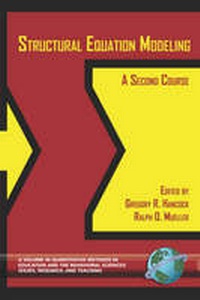
Structural Equation Modeling
A Second Course
Published on 6. January 2006
Book
Paperback/Softback
448 pages
978-1-59311-014-7 (ISBN)
Description
This volume is intended to serve as a didactically-oriented resource covering a broad range of advanced topics often not discussed in introductory courses on structural equation modeling (SEM). Such topics are important in furthering the understanding of foundations and assumptions underlying SEM as well as in exploring SEM as a potential tool to address new types of research questions that might not have arisen during a first course. Chapters focus on the clear explanation and application of topics, rather than on analytical derivations, and contain syntax and partial output files from popular SEM software.
Reviews / Votes
I believe that this volume represents a vital contribution to the field of SEM beyond the introductory level. From the Preface by Richard G. Lomax, The University of AlabamaMore details
Series
Language
English
Place of publication
Charlotte
United States
Publishing group
Emerald Publishing Inc
Target group
College/higher education
Professional and scholarly
Dimensions
Height: 234 mm
Width: 156 mm
Thickness: 23 mm
Weight
625 gr
ISBN-13
978-1-59311-014-7 (9781593110147)
Copyright in bibliographic data and cover images is held by Nielsen Book Services Limited or by the publishers or by their respective licensors: all rights reserved.
Schweitzer Classification
Other editions
New editions
Book
03/2013
2nd Edition
Information Age Publishing
€121.40
Shipment within 3-4 weeks
Content
Introduction to Series; Ronald C. Serlin.
Preface; Richard G. Lomax.
Dedication.
Acknowledgements.
Introduction; Gregory R. Hancock & Ralph O. Mueller.
Part I. Foundations.
Chapter 1. The Problem of Equivalent Structural Models; Scott L. Hershberger.
Chapter 2. Formative Measurement and Feedback Loops; Rex B. Kline.
Chapter 3. Power Analysis in Covariance Structure Modeling; Gregory R. Hancock.
Part II. Extensions.
Chapter 4. Evaluating Between-Group Differences in Latent Variable Means; Marilyn S. Thompson & Samuel B. Green.
Chapter 5. Using Latent Growth Models to Evaluate Longitudinal Change; Gregory R. Hancock & Frank R. Lawrence.
Chapter 6. Mean and Covariance Structure Mixture Models; Phill Gagne.
Chapter 7. Structural Equation Models of Latent Interaction and Quadratic Effects; Herbert W. Marsh, Zhonglin Wen, & Kit-Tai Hau.
Part III. Assumptions.
Chapter 8. Nonnormal and Categorical Data in Structural Equation Modeling; Sara J. Finney & Christine DiStefano.
Chapter 9. Analyzing Structural Equation Models with Missing Data; Craig K. Enders.
Chapter 10. Using Multilevel Structural Equation Modeling Techniques with Complex Sample Data; Laura M. Stapleton.
Chapter 11. The Use of Monte Carlo Studies in Structural Equation Modeling Research; Deborah L. Bandalos.
About the Authors.
Preface; Richard G. Lomax.
Dedication.
Acknowledgements.
Introduction; Gregory R. Hancock & Ralph O. Mueller.
Part I. Foundations.
Chapter 1. The Problem of Equivalent Structural Models; Scott L. Hershberger.
Chapter 2. Formative Measurement and Feedback Loops; Rex B. Kline.
Chapter 3. Power Analysis in Covariance Structure Modeling; Gregory R. Hancock.
Part II. Extensions.
Chapter 4. Evaluating Between-Group Differences in Latent Variable Means; Marilyn S. Thompson & Samuel B. Green.
Chapter 5. Using Latent Growth Models to Evaluate Longitudinal Change; Gregory R. Hancock & Frank R. Lawrence.
Chapter 6. Mean and Covariance Structure Mixture Models; Phill Gagne.
Chapter 7. Structural Equation Models of Latent Interaction and Quadratic Effects; Herbert W. Marsh, Zhonglin Wen, & Kit-Tai Hau.
Part III. Assumptions.
Chapter 8. Nonnormal and Categorical Data in Structural Equation Modeling; Sara J. Finney & Christine DiStefano.
Chapter 9. Analyzing Structural Equation Models with Missing Data; Craig K. Enders.
Chapter 10. Using Multilevel Structural Equation Modeling Techniques with Complex Sample Data; Laura M. Stapleton.
Chapter 11. The Use of Monte Carlo Studies in Structural Equation Modeling Research; Deborah L. Bandalos.
About the Authors.