

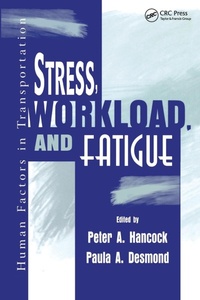
Stress, Workload, and Fatigue
1st Edition
Published on 2. December 2019
Book
Paperback/Softback
700 pages
978-0-367-44731-1 (ISBN)
Description
The purpose of this volume is to seek out, describe, and explain the shared commonalities of stress, fatigue, and workload. To understand and predict human performance response, we have to reach beyond the sterile, information-processing models to incorporate the emotive, affective, or more generally, energetic aspects of cognition. These facets of behavior surface most readily when the individual acts under stress, is faced by significant cognitive workload, or is in the grip of fatigue. However, energetic characteristics are pervasive and exert a vital and ubiquitous influence, even when they are not obviously in play as in extreme circumstances. Indeed, one cannot hope to understand behavior without their inclusion and integration into models and theories. This text addresses such theoretical questions as one of its main thrusts. However, in addition to the drive for scientific understanding, there are requirements in our progressively more utilitarian society which generate the need for a more fundamental understanding of this particular topic.
More details
Language
English
Place of publication
London
United Kingdom
Publishing group
Taylor & Francis Ltd
Target group
Professional and scholarly
Academic and Professional Practice & Development
Dimensions
Height: 234 mm
Width: 156 mm
Thickness: 37 mm
Weight
1045 gr
ISBN-13
978-0-367-44731-1 (9780367447311)
Copyright in bibliographic data and cover images is held by Nielsen Book Services Limited or by the publishers or by their respective licensors: all rights reserved.
Schweitzer Classification
Other editions
Additional editions
Peter A. Hancock | Paula A. Desmond
Stress, Workload, and Fatigue
Book
11/2000
1st Edition
CRC Press
€302.60
Shipment within 10-20 days
Persons
Content
Contents: B. Kantowitz, Series Foreword. Preface. Part I:Stress.Section 1:Theory.G. Matthews, Levels of Transaction: A Cognitive Science Framework for Operator Stress. K.C. Hendy, K.P. East, P.S.E. Farrell, An Information-Processing Model of Operator Stress and Performance. Section 2:Research.J.L. Weaver, C. Bowers, E. Salas, Stress and Teams: Performance Effects and Interventions. A.F. Stokes, K. Kite, On Grasping a Nettle and Becoming Emotional. G. Matthews, A Transactional Model of Driver Stress. Section 3:Practice.I. Glendon, F. Coles, Stress in Ambulance Staff. B. Thompson, A. Kirk-Brown, D. Brown, Women Police: The Impact of Work Stress on Family Members. G. Matthews, P.A. Desmond, Stress and Driving Performance: Implications for Design and Training. Section 4:Commentary.C.L. Cooper, S. Cartwright, A Strategic Approach to Organizational Stress Management. M.E. Morphew, The Future of Human Performance and Stress Research: A New Challenge. Part II:Workload.Section 1:Theory.M.W. Scerbo, Stress, Workload, and Boredom in Vigilance: A Problem and an Answer. R.W. Backs, An Autonomic Space Approach to the Psychophysiological Assessment of Mental Workload. D.D. Woods, E.S. Patterson, How Unexpected Events Produce an Escalation of Cognitive and Coordinative Demands. Section 2:Research.R. Parasuraman, P.A. Hancock, Adaptive Control of Mental Workload. K.A. Brookhuis, D. de Waard, Assessment of Drivers' Workload: Performance and Subjective and Physiological Indexes. M. Mouloua, J.M. Hitt, II, J. Deaton, Automation and Workload in Aviation Systems. T.C. Landsdown, Causes, Measures, and Effects of Driver Visual Workload. Section 3:Practice.A.D. Andre, The Value of Workload in the Design and Analysis of Consumer