

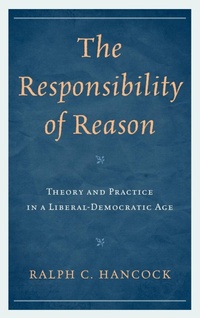
The Responsibility of Reason
Theory and Practice in a Liberal-Democratic Age
Published on 16. March 2011
Book
Hardback
346 pages
978-1-4422-0737-0 (ISBN)
Description
Can we run our lives and govern our societies by reason? The question provoked Socrates to redirect philosophic inquiry in a political direction, and it has remained fundamental to Western thought. Martin Heidegger explored this problem in his profound critique of the Western metaphysical tradition, and Leo Strauss responded to Heidegger with an attempt to recover the classical idea of the rule of reason.
In The Responsibility of Reason, Ralph C. Hancock undertakes no less than to answer the Heideggerian challenge. Offering trenchant and original interpretations of Aristotle, Heidegger, Strauss, and Alexis de Tocqueville, he argues that Tocqueville saw the essential more clearly than apparently deeper philosophers. Hancock addresses political theorists on the question of the grounding of liberalism, and, at the same time, philosophers on the most basic questions of the meaning and limits of reason. Moreover, he shows how these questions are for us inseparable.
In The Responsibility of Reason, Ralph C. Hancock undertakes no less than to answer the Heideggerian challenge. Offering trenchant and original interpretations of Aristotle, Heidegger, Strauss, and Alexis de Tocqueville, he argues that Tocqueville saw the essential more clearly than apparently deeper philosophers. Hancock addresses political theorists on the question of the grounding of liberalism, and, at the same time, philosophers on the most basic questions of the meaning and limits of reason. Moreover, he shows how these questions are for us inseparable.
Reviews / Votes
In a synthesis of separate studies of Alexis de Tocqueville, Martin Luther and John Calvin, Martin Heidegger, and Leo Strauss, Hancock (Brigham Young Univ.) critiques "the spiritual-intellectual framework of modern democracy." His thesis is that modern democracy rests on the unsustainable modern "illusion of the simple superiority of 'theory' to 'practice'" and that "the circulation of meaning between these poles must be accepted and assumed into the very self-understanding of reason." Though critiques of democratic theory abound, Hancock holds that in the postmodern age, the analysis and resolution by Tocqueville is superior to that of Heidegger, Strauss, and contemporary philosophers such as John Rawls and Charles Taylor. The "responsibility of reason" must be a political responsibility, deeply informed by inherited values and practices that sustain individual and social flourishing while offering a critical standpoint from which to question them. Humility in the face of what cannot be known is part of this responsibility....Recommended. * Choice Reviews * Hancock suggests that a humanly responsible reason depends on a renewed respect for Christian morality instead of a continued pursuit of an ultimately destructive autonomy. He echoes (knowingly or unknowingly) a paradoxical theme emphasized by the two most recent popes: Reason achieves its full stature-judging the goodness of the ends we pursue, not merely calculating the means to achieve whatever we happen to want-only when it is united with faith. While those captivated by the secular rationalism that dominates so much of our elite culture will surely resist Hancock's conclusion, his valuable book shows the only way to overcome democratic modernity's loss of confidence in moral reason. * First Things * For anyone seriously committed to assessing the stakes of contemporary Mormon theology, Hancock's recent book, The Responsibility of Reason: Theory and Practice in a Liberal-Democratic Age, is essential reading. . . .In the end, Hancock has productively and successively provided an account of the basic stakes of what remains the central question of Western thought. * BYU Studies Quarterly * Ralph C. Hancock has written a book that combines thinking at the highest level with deep moral seriousness and an admirable attentiveness to the requirements of political responsibility. His theme is the relationship between theory and practice, politics and philosophy, a subject that he explores with rare depth. He sets out to restore a conception of reason that is truly open to the transcendent purposes and norms that provide reason's compass, and thus avoids the illusion that philosophy is a radically 'autonomous' enterprise, even as it never forgets its debts to ordinary experience and decent politics. -- Daniel J. Mahoney, Assumption College Ralph C. Hancock has written a magisterial work of prodigious scholarship, sharp synthesis, and elegance which concentrates on the responsibility of reason in relation to both revealed theology and political life. His work identifies the liberal democratic dilemmas of the modern theological-political problem in Calvin and Tocqueville, the contrasting insights of Maimonides, the Kalam, and Aquinas. Hancock provides us with an elegant and compelling case for the view that liberal democracies must confront the truths of philosophy and theology and that without these two truths apprehended in tension, the vitality of liberal democracy is greatly diminished. -- Kenneth L. Deutsch, State University of New York at GeneseoMore details
Language
English
Place of publication
United States
Publishing group
Bloomsbury Publishing Plc
Target group
College/higher education
Dimensions
Height: 235 mm
Width: 157 mm
Thickness: 25 mm
Weight
713 gr
ISBN-13
978-1-4422-0737-0 (9781442207370)
Copyright in bibliographic data and cover images is held by Nielsen Book Services Limited or by the publishers or by their respective licensors: all rights reserved.
Schweitzer Classification
Other editions
Additional editions
E-Book
01/2011
1st Edition
Rowman & Littlefield Publishers
€144.99
Available for download
E-Book
01/2011
1st Edition
Rowman & Littlefield Publishers
€144.99
Available for download
Person
Ralph C. Hancock is professor of political science at Brigham Young University.
Content
Preface
Chapter 1: Reason's Meaning and Responsibility in a Liberal-Democratic Age
Chapter 2: The Crisis of "Moral Analogy" and the Problem of the Rule of Reason
Chapter 3: The Rule of Reason and Paradoxes of Transcendence
Chapter 4: Heidegger's Rejection and Radicalization of Modern Transcendence
Chapter 5: Leo Strauss and the Nobility of Philosophy
Chapter 6: Tocqueville's Responsible Reason
Chapter 7: Reason's Postmodern Responsibility
Index
Chapter 1: Reason's Meaning and Responsibility in a Liberal-Democratic Age
Chapter 2: The Crisis of "Moral Analogy" and the Problem of the Rule of Reason
Chapter 3: The Rule of Reason and Paradoxes of Transcendence
Chapter 4: Heidegger's Rejection and Radicalization of Modern Transcendence
Chapter 5: Leo Strauss and the Nobility of Philosophy
Chapter 6: Tocqueville's Responsible Reason
Chapter 7: Reason's Postmodern Responsibility
Index