

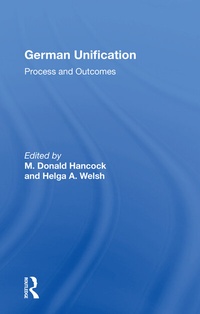
German Unification
Process And Outcomes
1st Edition
Published on 19. October 2020
Book
Paperback/Softback
394 pages
978-0-367-15893-4 (ISBN)
Description
This book is an international collaborative effort based on personal and professional witness by American and German social scientists to German unification as both process and outcome. It assesses some of the problems facing a united Germany.
More details
Language
English
Place of publication
London
United Kingdom
Publishing group
Taylor & Francis Ltd
Target group
College/higher education
Dimensions
Height: 229 mm
Width: 146 mm
Weight
750 gr
ISBN-13
978-0-367-15893-4 (9780367158934)
Copyright in bibliographic data and cover images is held by Nielsen Book Services Limited or by the publishers or by their respective licensors: all rights reserved.
Schweitzer Classification
Other editions
Additional editions
Book
04/2019
1st Edition
Routledge
€179.51
Shipment within 15-20 days
E-Book
03/2019
1st Edition
Routledge
€59.49
Available for download
E-Book
03/2019
1st Edition
Routledge
€59.49
Available for download
Person
M. Donald Hancock is Professor of Political Science and Director of the Center for European Studies at Vanderbilt University. He is the author of West Germany: The Politics of Democratic Corporatism (1989) and co-author and co-editor of Managing Modern Capitalism: Industrial Renewal and Workplace Democracy in Western Europe and the United States (1992, together with John Logue and Bernt Schiller). His research focuses on the political economy of Sweden, Germany, and the European Community. Helga A. Welsh holds a Ph.D. in Political Science from the University of Munich and for several years was a research fellow at the Institute for Contemporary History in Munich. She has held visiting appointments at the University of South Carolina and the University of Arizona, and is currently Visiting Assistant Professor at Wake Forest University. She specializes in European politics and has published in the areas of German history and politics and in comparative East European Studies.
Content
Introduction Part One: Background and Impetus 1. The Collapse of Communism in Eastern Europe and the GDR: Evolution, Revolution, and Diffusion 2. West German Policy Toward East Germany: A Motor of Unification? Part Two: Process and Outcomes 3. Delegitimation of the Old Regime: Reforming and Transforming Ideas in the Last Years of the GDR 4. Steps Toward Union: The Collapse of the GDR and the Unification of Germany 5. Exiting the GDR: Political Movements and Parties Between Democratization and Westernization 6. Parties and Problems of Governance During Unification 7. An Unwelcome Enlargement? The European Community and German Unification Part Three: Consequences and Problematics 8. An Impossible Dream? Privatizing Collective Property in Eastern Germany 9. Social Policy at a Crossroads 10. Economic and Political Performance: Patterns and Prospects 11. German Security Policy in Post-Yalta Europe 12. Germany in Transition: The Challenge of Coping with Unification 13. Conclusion: Beyond Unification