

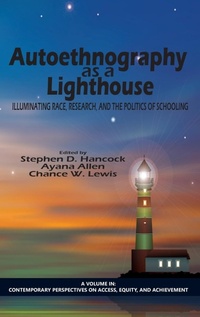
Autoethnography as a Lighthouse
Illuminating Race, Research, and the Politics of Schooling
Published on 19. February 2015
Book
Hardback
194 pages
978-1-62396-823-6 (ISBN)
Description
This work uses autoethnography as an enterprise to deconstruct barriers that support the invisibility of diverse epistemologies. The reality of invisibility and silence has plagued "unvalued others" in their attempt to make known the cultural significance found in the planning and execution of research. As a result, this book purposes to support the visibility and voice of marginalized scholars who conduct autoethnographic research from a racial, gendered, and critical theoretical framework. This work further supports authentic inquiry as it examines and reexamines culturally diverse epistemologies as a viable and valuable framework for conducting autoethnographic research. Specifically, this work highlights racialized epistemologies as an inescapable factor in auotethnographic research in the context of schools.
More details
Series
Language
English
Place of publication
Charlotte
United States
Publishing group
Emerald Publishing Inc
Target group
Professional and scholarly
Dimensions
Height: 240 mm
Width: 161 mm
Thickness: 15 mm
Weight
461 gr
ISBN-13
978-1-62396-823-6 (9781623968236)
Copyright in bibliographic data and cover images is held by Nielsen Book Services Limited or by the publishers or by their respective licensors: all rights reserved.
Schweitzer Classification
Persons
Stephen Hancock Ph.D., University of North Carolina at Charlotte, USA
Ayana Allen Ph.D., University of North Carolina at Charlotte, USA
Chance W. Lewis, University of North Carolina at Charlotte
Ayana Allen Ph.D., University of North Carolina at Charlotte, USA
Chance W. Lewis, University of North Carolina at Charlotte
Content
Part I: Illuminating Racialized Inquiry Through Autoethnography.
Introduction.
Chapter 1. Common Threads: Culturalized Patterns and Conceptual Understandings of Race, Research, and the Politics of Schooling, Stephen D. Hancock and Ayana Allen.
Chapter 2. Your Inquiry Is Not Like Mine: Structuring a Critical Constructivist Approach to Autoethnographic Inquiry, Stephen D. Hancock.
Chapter 3. Going Native/Being Native: The Promise of Critical Co-Constructed Autoethnography for Checking Race, Class, and Gender In/Out of the Field, Sherick Hughes and Kate Willink.
Chapter 4. Autoethnography as Counternarrative: Confronting Myths in the Academy-An African American Female Perspective, Lisa R. Merriweather.
Part II: Voicing of the Silenced Through Autoethnography.
Chapter 5. From Being Considered At-Risk to Becoming Resilient: An Autoethnography of an Immigrant Child Finding Her Voice in Becoming a U.S. Citizen, Rosalinda Mercado-Garza.
Chapter 6. Race, Gender, and Single Parenting: Dismantling the Invisible Myth Around Intellectual Black Female Scholars, Andrea L. Tyler and Lameesa Muhammad.
Chapter 7. Fragmented but Unbroken: Forming a Black White Biracial Identity in the South, Anthony Ash.
Part III: Investigating Identities in Schools Through Autoethnographic Lenses.
Chapter 8. Black-Self/White-Context: An Autoethnography of Hurt, Hope, and Heroism in Predominantly White Schools, Ayana Allen.
Chapter 9. Black Women Professors' Evolving Teacher Identities: Reconciling Past, Present, and Future, Tambra O. Jackson and Michelle L. Bryan.
Chapter 10. Stimulating Conversions: Critical Teaching, Changing Paradigms, and the Politics of Schooling in an Urban Elementary Context, Stephen D. Hancock.
Chapter 11. The Implications of Autoethnographic Research for Access to Equity and Achievement, Ayana Allen, Stephen D. Hancock, and Chance W. Lewis.
Author Biographies.
Introduction.
Chapter 1. Common Threads: Culturalized Patterns and Conceptual Understandings of Race, Research, and the Politics of Schooling, Stephen D. Hancock and Ayana Allen.
Chapter 2. Your Inquiry Is Not Like Mine: Structuring a Critical Constructivist Approach to Autoethnographic Inquiry, Stephen D. Hancock.
Chapter 3. Going Native/Being Native: The Promise of Critical Co-Constructed Autoethnography for Checking Race, Class, and Gender In/Out of the Field, Sherick Hughes and Kate Willink.
Chapter 4. Autoethnography as Counternarrative: Confronting Myths in the Academy-An African American Female Perspective, Lisa R. Merriweather.
Part II: Voicing of the Silenced Through Autoethnography.
Chapter 5. From Being Considered At-Risk to Becoming Resilient: An Autoethnography of an Immigrant Child Finding Her Voice in Becoming a U.S. Citizen, Rosalinda Mercado-Garza.
Chapter 6. Race, Gender, and Single Parenting: Dismantling the Invisible Myth Around Intellectual Black Female Scholars, Andrea L. Tyler and Lameesa Muhammad.
Chapter 7. Fragmented but Unbroken: Forming a Black White Biracial Identity in the South, Anthony Ash.
Part III: Investigating Identities in Schools Through Autoethnographic Lenses.
Chapter 8. Black-Self/White-Context: An Autoethnography of Hurt, Hope, and Heroism in Predominantly White Schools, Ayana Allen.
Chapter 9. Black Women Professors' Evolving Teacher Identities: Reconciling Past, Present, and Future, Tambra O. Jackson and Michelle L. Bryan.
Chapter 10. Stimulating Conversions: Critical Teaching, Changing Paradigms, and the Politics of Schooling in an Urban Elementary Context, Stephen D. Hancock.
Chapter 11. The Implications of Autoethnographic Research for Access to Equity and Achievement, Ayana Allen, Stephen D. Hancock, and Chance W. Lewis.
Author Biographies.