

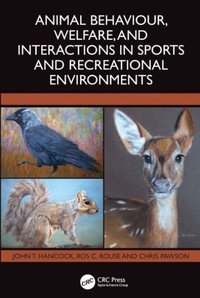
Animal Behaviour, Welfare, and Interactions in Sports and Recreational Environments
1st Edition
Will be published approx. on 31. August 2026
Book
Paperback/Softback
292 pages
978-1-032-98622-7 (ISBN)
Description
Human-animal interactions are often a significant part of our experience in sport and recreational settings. Animals contribute to the quality of these environments as well as our subjective leisure experience, but coexistence can also provide challenges. Starting from the smallest nematode and working up to bears and alligators, this book explores the impact of animals in this arena, discussing how animal behaviour impacts sport and recreation, often positively and sometimes negatively, and, in turn, how humans impact animals in these spaces.
Sports and leisure facilities around the world invest significantly in managing interactions with animals to support the quality of recreational experience and the health of both human and nonhuman animals. Bringing together the expertise of the authors in biology, animal behaviour, anthrozoology and psychology, this book discusses ways to encourage, or discourage, animals in sports and leisure settings, whilst always observing best possible welfare and conservation practice. The text is supported by reference to news and media outlets as well as scientific literature.
In exploring our relationships with animals in areas highly managed by humans, this book aims to progress how facilities can be improved. It also adopts a One World lens encouraging us to interrogate our preconceived ideas about the animals with which we share these spaces and ultimately hopes that, with better understanding, animals will be treated with respect and wonder rather than seen as a source of conflict.
Sports and leisure facilities around the world invest significantly in managing interactions with animals to support the quality of recreational experience and the health of both human and nonhuman animals. Bringing together the expertise of the authors in biology, animal behaviour, anthrozoology and psychology, this book discusses ways to encourage, or discourage, animals in sports and leisure settings, whilst always observing best possible welfare and conservation practice. The text is supported by reference to news and media outlets as well as scientific literature.
In exploring our relationships with animals in areas highly managed by humans, this book aims to progress how facilities can be improved. It also adopts a One World lens encouraging us to interrogate our preconceived ideas about the animals with which we share these spaces and ultimately hopes that, with better understanding, animals will be treated with respect and wonder rather than seen as a source of conflict.
More details
Language
English
Place of publication
London
United Kingdom
Publishing group
Taylor & Francis Ltd
Target group
Professional and scholarly
Academic and Professional Reference
Illustrations
6 farbige Tabellen, 5 farbige Zeichnungen, 37 Farbfotos bzw. farbige Rasterbilder, 42 farbige Abbildungen
6 Tables, color; 5 Line drawings, color; 37 Halftones, color; 42 Illustrations, color
Dimensions
Height: 254 mm
Width: 178 mm
ISBN-13
978-1-032-98622-7 (9781032986227)
Copyright in bibliographic data and cover images is held by Nielsen Book Services Limited or by the publishers or by their respective licensors: all rights reserved.
Schweitzer Classification
Other editions
Additional editions
John T. Hancock | Ros C. Rouse | Chris Pawson
Animal Behaviour, Welfare, and Interactions in Sports and Recreational Environments
Book
approx. 08/2026
1st Edition
CRC Press
€167.50
Not yet published
John T. Hancock | Ros C. Rouse | Chris Pawson
Animal Behaviour, Welfare, and Interactions in Sports and Recreational Environments
E-Book
approx. 08/2026
CRC Press
€69.99
Not yet available
John T. Hancock | Ros C. Rouse | Chris Pawson
Animal Behaviour, Welfare, and Interactions in Sports and Recreational Environments
E-Book
approx. 08/2026
CRC Press
€69.99
Not yet available
Persons
John T. Hancock is Professor of Cell Signalling at the University of West of England, Bristol (UWE) UK. He studied at the University of Bristol where he obtained a BSc(Hons) in Biochemistry (1984) and then a PhD (1987). He stayed at Bristol where he held post-doctoral research positions for six years, before he moved to UWE in 1993. He has been at UWE ever since. John has a long-standing interest in how small relatively reactive molecules are able to partake in cell signalling events in cells. This often centres around the chemistry of reduction and oxidation (redox). He has authored several editions of the textbook as well as publishing over two hundred academic articles. He holds several editorial positions with journals, most notably being the Editor-in-Chief of the journals Oxygen and Journal of Plant Physiology and Metabolism. Recently, John has published the book Why Elephants Cry: How Observing Unusual Animal Behaviours Can Predict the Weather (and other Environmental Phenomena) with CRC Press. He has also written several articles on COVID-19, including about the impact of the pandemic on animals and animal welfare, and coauthored the book Animal Welfare in a Pandemic: What does COVID-19 tell us for the future?, also with CRC Press.
Ros C. Rouse originally studied Psychology at the University of Bristol. She is a science policy expert with extensive Research Council experience. Ros concentrated on promoting integrity in research at the University of the West of England, and was a member of the University's Ethics and Integrity Committee. She has a strong personal commitment to the welfare of animals, and believes that every animal counts. Ros is committed to a vision of One Health in which the health and wellbeing of animals is considered, as well as the impact of their health on humans. Ros has co-authored several articles on COVID-19 and animals, as well as the book Animal Welfare in a Pandemic: What does COVID-19 tell us for the future? with CRC Press. Ros is also an artist, focussing on wildlife and the natural world.
Chris Pawson is a Reader in Anthrozoology at Hartpury University, and Associate Professor in Applied Behavioural Science at the University of the West of England. Chris completed his PhD in Psychology in London and worked as a Home Office researcher before developing an interest in applying evolutionary and behavioural ecology approaches to explaining behaviour. This led him to further postgraduate study in primatology and his current interests in the field of human-animal interaction, which include the challenges posed by human and nonhuman animal coexistence, but also the benefits humans derive from interactions with animals and sharing space with them.
Ros C. Rouse originally studied Psychology at the University of Bristol. She is a science policy expert with extensive Research Council experience. Ros concentrated on promoting integrity in research at the University of the West of England, and was a member of the University's Ethics and Integrity Committee. She has a strong personal commitment to the welfare of animals, and believes that every animal counts. Ros is committed to a vision of One Health in which the health and wellbeing of animals is considered, as well as the impact of their health on humans. Ros has co-authored several articles on COVID-19 and animals, as well as the book Animal Welfare in a Pandemic: What does COVID-19 tell us for the future? with CRC Press. Ros is also an artist, focussing on wildlife and the natural world.
Chris Pawson is a Reader in Anthrozoology at Hartpury University, and Associate Professor in Applied Behavioural Science at the University of the West of England. Chris completed his PhD in Psychology in London and worked as a Home Office researcher before developing an interest in applying evolutionary and behavioural ecology approaches to explaining behaviour. This led him to further postgraduate study in primatology and his current interests in the field of human-animal interaction, which include the challenges posed by human and nonhuman animal coexistence, but also the benefits humans derive from interactions with animals and sharing space with them.
Content
1. Introduction: why consider animals at sports grounds and leisure facilities? 2. Nematodes and the generation of good plant growth conditions 3. Worms: the good and the bad 4. Aquatic environments 5. Insects: nests and food 6. Birds: good to see, but creating havoc, or having havoc created against them? 7. Rodents 8. Moles, Lagomorphs, and burrowing mammals 9. Bats: the flying mammals 10. Companion animals 11. Large animals and their impact 12. The Law: a brief exploration of laws, regulations and governance which recreational facilities should be cognisant of 13. One Health: Sport and Recreation Venues as a Context for Healthy Wildlife and Healthy Humans 14. Final conclusions and summary