

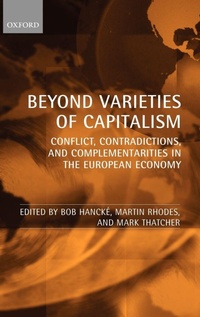
Beyond Varieties of Capitalism
Conflict, Contradictions, and Complementarities in the European Economy
Published on 17. May 2007
Book
Hardback
448 pages
978-0-19-920648-3 (ISBN)
Description
Since the early 1990s, Europe's economies have been facing several new challenges: the 1992 single market programme, the collapse of the Berlin wall and eastward enlargement, and monetary unification. Building on the influential Varieties of Capitalism (VoC) perspective, first elaborated in detail in the book Varieties of Capitalism (OUP, 2001), this book critically analyzes these developments in the European political economy and their effects on the continental European economies.
Leading political economists from Europe and the US debate how VoC can help understand the political-economic challenges that Europe is facing today and how understanding these new challenges can in turn enrich and enhance the VoC perspective. Thematically, the contributions to this volume are organised in four sections:
* how the macro-economics of EMU influenced different European models of capitalism,
* how the Single Market programme was received in the different institutional regimes in European capitalism,
* how welfare and labour market reforms are debated and implemented,
* how European capitalism travelled east after 1989.
Preceding this is a spirited defence of the VoC approach by Peter Hall, and an introduction from the volume editors, considering the approach, and proposing extensions and amendments. This book demonstrates that the VoC approach remains, as the editors put it in their introduction, a rich seam to mine, capable of accommodating new developments, and theoretically flexible enough to branch out into new arguments.
Leading political economists from Europe and the US debate how VoC can help understand the political-economic challenges that Europe is facing today and how understanding these new challenges can in turn enrich and enhance the VoC perspective. Thematically, the contributions to this volume are organised in four sections:
* how the macro-economics of EMU influenced different European models of capitalism,
* how the Single Market programme was received in the different institutional regimes in European capitalism,
* how welfare and labour market reforms are debated and implemented,
* how European capitalism travelled east after 1989.
Preceding this is a spirited defence of the VoC approach by Peter Hall, and an introduction from the volume editors, considering the approach, and proposing extensions and amendments. This book demonstrates that the VoC approach remains, as the editors put it in their introduction, a rich seam to mine, capable of accommodating new developments, and theoretically flexible enough to branch out into new arguments.
More details
Language
English
Place of publication
Oxford
United Kingdom
Target group
Professional and scholarly
Illustrations
Numerous tables and figures
Dimensions
Height: 240 mm
Width: 161 mm
Thickness: 29 mm
Weight
845 gr
ISBN-13
978-0-19-920648-3 (9780199206483)
Copyright in bibliographic data and cover images is held by Nielsen Book Services Limited or by the publishers or by their respective licensors: all rights reserved.
Schweitzer Classification
Other editions
Additional editions
Bob Hancke | Martin Rhodes | Mark Thatcher
Beyond Varieties of Capitalism
Conflict, Contradictions, and Complementarities in the European Economy
Book
06/2008
Oxford University Press
€67.70
Shipment within 15-20 days
Persons
Bob Hancke is a Reader in European Political Economy at the London School of Economics and Political Science. Previous appointments were at the Wissenschaftszentrum Berlin, at the J.F. Kennedy School and the Center for European Studies at Harvard University, as a Jean Monnet Fellow at the EUI in Florence, and as a doctoral researcher at MIT. He published Large Firms and Institutional Change (Oxford University Press, 2002), and participated in the project that led to Varieties of Capitalism? edited by Peter Hall and David Soskice (Oxford University Press, 2001). His research interests are the political economy of advanced capitalist societies, the relation between institutions and macro-economic policy, and labour relations.
Martin Rhodes is a Professor of Comparative Political Economy, Graduate School of International Studies, University of Denver, Colorado. Until December 2005, he was Professor of Public Policy in the Department of Social and Political Science at the European University Institute in Florence. He has written widely on issues of comparative European political economy, including social pacts and welfare and labour market reform, and is currently directing a project on pensions systems and pension reforms in Europe. He is the scientific director of the European research consortium on 'New Modes of Governance' and within that consortium is running a new project on social pacts and tripartism in western and eastern Europe with Jelle Visser of the University of Amsterdam.
Mark Thatcher is a Reader in Public Administration and Public Policy at the London School of Economics and Political Science. He read Philosophy, Politics, and Economics at Balliol College Oxford, then qualified as a Barrister, and took his doctorate at Nuffield College, Oxford. He spent five years researching and lecturing in Paris (Ecole Nationale Superieure des Telecommunications, Paris III- Sorbonne Nouvelle, Sciences-Po Paris), before joining the LSE in 1995. He has been a Fellow at the Robert Schuman Centre, European University Institute, Florence. His research interests are Comparative Public Policy and Regulation in Europe; Telecommunications and other utilities; and Independent Regulatory Agencies.
Martin Rhodes is a Professor of Comparative Political Economy, Graduate School of International Studies, University of Denver, Colorado. Until December 2005, he was Professor of Public Policy in the Department of Social and Political Science at the European University Institute in Florence. He has written widely on issues of comparative European political economy, including social pacts and welfare and labour market reform, and is currently directing a project on pensions systems and pension reforms in Europe. He is the scientific director of the European research consortium on 'New Modes of Governance' and within that consortium is running a new project on social pacts and tripartism in western and eastern Europe with Jelle Visser of the University of Amsterdam.
Mark Thatcher is a Reader in Public Administration and Public Policy at the London School of Economics and Political Science. He read Philosophy, Politics, and Economics at Balliol College Oxford, then qualified as a Barrister, and took his doctorate at Nuffield College, Oxford. He spent five years researching and lecturing in Paris (Ecole Nationale Superieure des Telecommunications, Paris III- Sorbonne Nouvelle, Sciences-Po Paris), before joining the LSE in 1995. He has been a Fellow at the Robert Schuman Centre, European University Institute, Florence. His research interests are Comparative Public Policy and Regulation in Europe; Telecommunications and other utilities; and Independent Regulatory Agencies.
Editor
, Reader in European Political Economy, London School of Economics and Political Science
, Professor of Public Policy, Department of Social and Political Sciences, European University Institute, Florence
, Senior Lecturer in Public Administration and Public Policy, London School of Economics and Political Science
Content
PART 1: VARIETIES OF CAPITALISM: TAKING STOCK; PART 2: MACRO-ADJUSTMENT AND VARIETIES OF CAPITALISM; PART 3: THE SINGLE MARKET, REGULATION, AND FIRMS; PART 4: LABOUR MARKET AND WELFARE STATE ADJUSTMENT; PART 5: CAPITALISM GOES EAST