

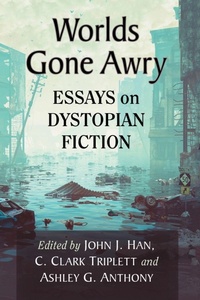
Worlds Gone Awry
Essays on Dystopian Fiction
Published on 30. August 2018
Book
Paperback/Softback
259 pages
978-1-4766-7180-2 (ISBN)
Description
Dystopian fiction captivates us by depicting future worlds at once eerily similar and shockingly foreign to our own. This collection of new essays presents some of the most recent scholarship on a genre whose popularity has surged dramatically since the 1990s. Contributors explore such novels as The Lord of the Flies, The Heart Goes Last, The Giver and The Strain Trilogy as social critique, revealing how they appeal to the same impulse as utopian fiction: the desire for an idealized yet illusory society in which evil is purged and justice prevails.
Reviews / Votes
"A solid collection and is especially useful because of the range of authors and titles covered...an especially informative study...the quality of essays is high, and the editors deserve credit for producing a volume that appears to be scrupulously proofread"-Science Fiction Studies.More details
Language
English
Place of publication
Jefferson, NC
United States
Target group
Professional and scholarly
Interest Age: From 18 years
Product notice
Paperback (trade)
Illustrations
notes, bibliographies, index
Dimensions
Height: 229 mm
Width: 152 mm
Thickness: 15 mm
Weight
427 gr
ISBN-13
978-1-4766-7180-2 (9781476671802)
Copyright in bibliographic data and cover images is held by Nielsen Book Services Limited or by the publishers or by their respective licensors: all rights reserved.
Schweitzer Classification
Persons
John J. Han is professor of English and creative writing and chair of the humanities division at Missouri Baptist University in St. Louis and is the author, editor, co-editor, compiler, or translator of 18 books. C. Clark Triplett is vice president for graduate studies and academic program review and professor of psychology/sociology at Missouri Baptist University in St. Louis. Ashley G. Anthony is an associate instructor of English at Maryville University, in St. Louis.
Content
Table of Contents
Acknowledgments
Introduction (John J. Han, C. Clark Triplett and Ashley G. Anthony)
Part One: Classical Dystopian Fiction
Feminine Subterfuge in Margaret Atwood's The Heart Goes Last (Megan E. Cannella)
"Forget sad things": Kurt Vonnegut's Dystopian Short Fiction
as Social Critique (Ashley G. Anthony)
"A secure but partly demented society": Reconsidering Human Depravity in William Golding's Lord of the Flies (Natasha W. Vashisht)
Streets of Spectrality: Kevin Barry's Dystopian City of Bohane (Deirdre Flynn)
Interrogating Utopia: On Colin MacInnes' Absolute Beginners (Andrew Hammond)
"What if I said that he's a god?": Messianism in Cormac
McCarthy's The Road (Wes Yeary)
"Maps and mazes": Mapping as Metaphor in Postsecular
America (Harold K. Bush)
Part Two: Popular Dystopian Fiction Unmasking the Deception: The Hermeneutic of Suspicion in Lois Lowry's The Giver
(C. Clark Triplett and John J. Han )111
Ending Dystopia: The Feminist Critique of Culture
in Suzanne Collins' Hunger Games Trilogy (Jane Beal)
Commodifying the Revolution: Dystopian Young Adult Literature and Cultural Critique (Jillian L. Canode)
Dystopia, Competition and Reality Television Tropes in The Bachman Books: "The Long Walk" and "The Running Man" (Alissa Burger)
Stranger Than Fiction: Locating the Digital Dystopia in Contemporary Fiction (Robyn N. Rowley)
Disembodied Heads and Headless Philosophies: C.S. Lewis'
Aesthetic Rejoinder to Dystopian Utility in That Hideous Strength
(Matthew Bardowell)
The Creation of the Future from Remnants of the Past: Order from Disorder in William Gibson's All Tomorrow's Parties and Neal Stephenson's Snow Crash (Melanie A. Marotta)
The Future Is White, the Future Is Undead: Reframing the American Vampire Dystopia in Guillermo del Toro and Chuck Hogan's The Strain Trilogy (Simon Bacon)
Here's Looking at You, Kids: The Urgency of Dystopian Texts
in the Secondary Classroom (Michael A. Soares)
About the Contributors
Index
Acknowledgments
Introduction (John J. Han, C. Clark Triplett and Ashley G. Anthony)
Part One: Classical Dystopian Fiction
Feminine Subterfuge in Margaret Atwood's The Heart Goes Last (Megan E. Cannella)
"Forget sad things": Kurt Vonnegut's Dystopian Short Fiction
as Social Critique (Ashley G. Anthony)
"A secure but partly demented society": Reconsidering Human Depravity in William Golding's Lord of the Flies (Natasha W. Vashisht)
Streets of Spectrality: Kevin Barry's Dystopian City of Bohane (Deirdre Flynn)
Interrogating Utopia: On Colin MacInnes' Absolute Beginners (Andrew Hammond)
"What if I said that he's a god?": Messianism in Cormac
McCarthy's The Road (Wes Yeary)
"Maps and mazes": Mapping as Metaphor in Postsecular
America (Harold K. Bush)
Part Two: Popular Dystopian Fiction Unmasking the Deception: The Hermeneutic of Suspicion in Lois Lowry's The Giver
(C. Clark Triplett and John J. Han )111
Ending Dystopia: The Feminist Critique of Culture
in Suzanne Collins' Hunger Games Trilogy (Jane Beal)
Commodifying the Revolution: Dystopian Young Adult Literature and Cultural Critique (Jillian L. Canode)
Dystopia, Competition and Reality Television Tropes in The Bachman Books: "The Long Walk" and "The Running Man" (Alissa Burger)
Stranger Than Fiction: Locating the Digital Dystopia in Contemporary Fiction (Robyn N. Rowley)
Disembodied Heads and Headless Philosophies: C.S. Lewis'
Aesthetic Rejoinder to Dystopian Utility in That Hideous Strength
(Matthew Bardowell)
The Creation of the Future from Remnants of the Past: Order from Disorder in William Gibson's All Tomorrow's Parties and Neal Stephenson's Snow Crash (Melanie A. Marotta)
The Future Is White, the Future Is Undead: Reframing the American Vampire Dystopia in Guillermo del Toro and Chuck Hogan's The Strain Trilogy (Simon Bacon)
Here's Looking at You, Kids: The Urgency of Dystopian Texts
in the Secondary Classroom (Michael A. Soares)
About the Contributors
Index