

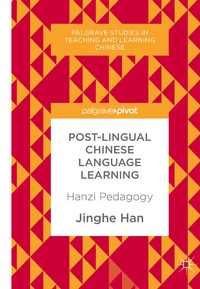
Post-Lingual Chinese Language Learning
Hanzi Pedagogy
Published on 1. August 2017
Book
Hardback
XIII, 131 pages
978-1-137-59839-4 (ISBN)
Description
This book presents a thought-provoking challenge to mainstream theories of second language learning. Focusing on Chinese Hanzi, a self-sufficient meaning-making system that operates via visual shape and the logic built into its formation, it analyses 'post-lingual' pedagogy. The author examines this 'language beyond language' or linguistic theories, demonstrating that Hanzi is not made up simply of arbitrary signs but is the result of a complete conceptualisation process. In doing so, she creates a conceptual framework that builds on Hanzi's humanistic spirit of language learning. This intriguing book will interest students and scholars of language education, and offers practical advice for those involved in teaching and learning Chinese as a foreign language.
More details
Series
Edition
1st ed. 2017
Language
English
Place of publication
London
United Kingdom
Target group
Professional and scholarly
Product notice
sewn/stitched
Cloth over boards
Illustrations
XIII, 131 p.
Dimensions
Height: 218 mm
Width: 154 mm
Thickness: 17 mm
Weight
329 gr
ISBN-13
978-1-137-59839-4 (9781137598394)
DOI
10.1057/978-1-137-59840-0
Schweitzer Classification
Other editions
Additional editions
Book
07/2018
Palgrave Macmillan
€58.84
Shipment within 15-20 days
E-Book
07/2017
1st Edition
Palgrave Macmillan
€58.84
Available for download
Person
Jinghe Han is Senior Lecturer at the Centre for Educational Research, Western Sydney University, Australia. Her research interests include post-lingual pedagogy, research literacy, and English as a Medium of Instruction.
Content
Chapter 1. Contextualising Chinese language education in the Western Context.- Chapter 2. Chinese language and Duiwai Hanyu Jiaoxue (Teaching Chinese as a Foreign Language).- Chapter 3. The debatable role of English (L1) in Duiwai Hanyu (L2) Jiaoxue (Teaching Chinese as a Foreign Language).- Chapter 4. Post-lingual pedagogical practice - Hanzi Method.- Chapter 5. Meaning-making - Hanzi orthography and real world integrated learning.- Chapter 6. Learning through the logic in Hanzi.- Chapter 7. Hanzi method - knowledge generation, concepts / conceptualization and thoughts in Hanzi.- Chapter 8. Further thoughts on Hanzi methods - the language, epistemology and ontology.