

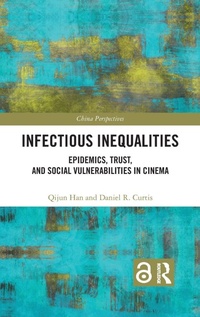
Infectious Inequalities
Epidemics, Trust, and Social Vulnerabilities in Cinema
1st Edition
Published on 22. December 2021
Book
Hardback
156 pages
978-1-032-19966-5 (ISBN)
Description
This book explores societal vulnerabilities highlighted within cinema and develops an interpretive framework for understanding the depiction of societal responses to epidemic disease outbreaks across cinematic history.
Drawing on a large database of twentieth- and twenty-first-century films depicting epidemics, the study looks into issues including trust, distrust, and mistrust; different epidemic experiences down the lines of expertise, gender, and wealth; and the difficulties in visualizing the invisible pathogen on screen. The authors argue that epidemics have long been presented in cinema as forming a point of cohesion for the communities portrayed, as individuals and groups "from below" represented as characters in these films find solidarity in battling a common enemy of elite institutions and authority figures. Throughout the book, a central question is also posed: "cohesion for whom?", which sheds light on the fortunes of those characters that are excluded from these expressions of collective solidarity.
This book is a valuable reference for scholars and students of film studies and visual studies as well as academic and general readers interested in topics of films and history, and disease and society.
The Open Access version of this book, available at http://www.taylorfrancis.com, has been made available under a Creative Commons Attribution-Non Commercial-No Derivatives 4.0 license.
Drawing on a large database of twentieth- and twenty-first-century films depicting epidemics, the study looks into issues including trust, distrust, and mistrust; different epidemic experiences down the lines of expertise, gender, and wealth; and the difficulties in visualizing the invisible pathogen on screen. The authors argue that epidemics have long been presented in cinema as forming a point of cohesion for the communities portrayed, as individuals and groups "from below" represented as characters in these films find solidarity in battling a common enemy of elite institutions and authority figures. Throughout the book, a central question is also posed: "cohesion for whom?", which sheds light on the fortunes of those characters that are excluded from these expressions of collective solidarity.
This book is a valuable reference for scholars and students of film studies and visual studies as well as academic and general readers interested in topics of films and history, and disease and society.
The Open Access version of this book, available at http://www.taylorfrancis.com, has been made available under a Creative Commons Attribution-Non Commercial-No Derivatives 4.0 license.
More details
Language
English
Place of publication
London
United Kingdom
Publishing group
Taylor & Francis Ltd
Target group
Professional and scholarly
College/higher education
General, Postgraduate, Professional, Undergraduate Advanced, and Undergraduate Core
Illustrations
24 s/w Abbildungen, 23 s/w Photographien bzw. Rasterbilder, 1 s/w Zeichnung
1 Line drawings, black and white; 23 Halftones, black and white; 24 Illustrations, black and white
Dimensions
Height: 240 mm
Width: 161 mm
Thickness: 14 mm
Weight
423 gr
ISBN-13
978-1-032-19966-5 (9781032199665)
Copyright in bibliographic data and cover images is held by Nielsen Book Services Limited or by the publishers or by their respective licensors: all rights reserved.
Schweitzer Classification
Other editions
Additional editions
Qijun Han | Daniel R. Curtis
Infectious Inequalities
Epidemics, Trust, and Social Vulnerabilities in Cinema
Book
09/2023
1st Edition
Routledge
€62.80
Shipment within 10-20 days
Qijun Han | Daniel R. Curtis
Infectious Inequalities
Epidemics, Trust, and Social Vulnerabilities in Cinema
E-Book
12/2021
1st Edition
Routledge
€0.00
Available for download
Qijun Han | Daniel R. Curtis
Infectious Inequalities
Epidemics, Trust, and Social Vulnerabilities in Cinema
E-Book
12/2021
1st Edition
Routledge
€0.00
Available for download
Persons
Qijun Han is Associate Professor at the School of Foreign Studies, Nanjing University of Science and Technology (China). She has published widely in film, media, and cultural studies in journals such as Cultural and Social History; Historical Journal of Film, Radio and Television; Critical Arts; Continuum; Gender and History; Visual Studies; and many more.
Daniel R. Curtis is Associate Professor at the Erasmus School of History, Culture and Communication, Erasmus University Rotterdam (The Netherlands). He has published widely in social and environmental history in journals such as Economic History Review; Speculum; Journal of Social History; Environment and History; American Journal of Physical Anthropology; Journal of Interdisciplinary History, Medical Humanities; and many more.
Daniel R. Curtis is Associate Professor at the Erasmus School of History, Culture and Communication, Erasmus University Rotterdam (The Netherlands). He has published widely in social and environmental history in journals such as Economic History Review; Speculum; Journal of Social History; Environment and History; American Journal of Physical Anthropology; Journal of Interdisciplinary History, Medical Humanities; and many more.
Content
1. Understanding Epidemics through the Cinematic Lens 2. Societal Responses to Epidemics: Immorality and Resistance 3. Suspicious Minds: Cinematic Depiction of Distrust during Epidemics 4. Bridging the Gap: Epidemics, Public Health Workers, and "Heroism" in Cinematic Perspective 5. From Spreaders to Sacrifice: Cinematic Representation of Women during Epidemic 6. Between Urban Depravity and Rural Backwardness: Cinematic Depiction of Poverty during Epidemics 7. Conclusion: Epidemics and Cinema in an Age of COVID-19