

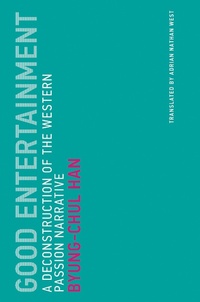
Good Entertainment
A Deconstruction of the Western Passion Narrative
Published on 8. October 2019
Book
Paperback/Softback
144 pages
978-0-262-53750-6 (ISBN)
Description
A philosopher considers entertainment, in all its totalizing variety-infotainment, edutainment, servotainment-and traces the notion through Kant, Zen Buddhism, Heidegger, Kafka, and Rauschenberg.
In Good Entertainment, Byung-Chul Han examines the notion of entertainment-its contemporary ubiquity, and its philosophical genealogy. Entertainment today, in all its totalizing variety, has an apparently infinite capacity for incorporation: infotainment, edutainment, servotainment, confrontainment. Entertainment is held up as a new paradigm, even a new credo for being-and yet, in the West, it has had inescapably negative connotations. Han traces Western ideas of entertainment, considering, among other things, the scandal that arose from the first performance of Bach's Saint Matthew's Passion (deemed too beautiful, not serious enough); Kant's idea of morality as duty and the entertainment value of moralistic literature; Heidegger's idea of the thinker as a man of pain; Kafka's hunger artist and the art of negativity, which takes pleasure in annihilation; and Robert Rauschenberg's refusal of the transcendent.
The history of the West, Han tells us, is a passion narrative, and passion appears as a killjoy. Achievement is the new formula for passion, and play is subordinated to production, gamified. And yet, he argues, at their core, passion and entertainment are not entirely different. The pure meaninglessness of entertainment is adjacent to the pure meaning of passion. The fool's smile resembles the pain-racked visage of Homo doloris. In Good Entertainment, Han explores this paradox.
In Good Entertainment, Byung-Chul Han examines the notion of entertainment-its contemporary ubiquity, and its philosophical genealogy. Entertainment today, in all its totalizing variety, has an apparently infinite capacity for incorporation: infotainment, edutainment, servotainment, confrontainment. Entertainment is held up as a new paradigm, even a new credo for being-and yet, in the West, it has had inescapably negative connotations. Han traces Western ideas of entertainment, considering, among other things, the scandal that arose from the first performance of Bach's Saint Matthew's Passion (deemed too beautiful, not serious enough); Kant's idea of morality as duty and the entertainment value of moralistic literature; Heidegger's idea of the thinker as a man of pain; Kafka's hunger artist and the art of negativity, which takes pleasure in annihilation; and Robert Rauschenberg's refusal of the transcendent.
The history of the West, Han tells us, is a passion narrative, and passion appears as a killjoy. Achievement is the new formula for passion, and play is subordinated to production, gamified. And yet, he argues, at their core, passion and entertainment are not entirely different. The pure meaninglessness of entertainment is adjacent to the pure meaning of passion. The fool's smile resembles the pain-racked visage of Homo doloris. In Good Entertainment, Han explores this paradox.
More details
Series
Language
English
Place of publication
Cambridge
United States
Publishing group
MIT Press Ltd
Target group
US School Grade: College Graduate Student and over
Product notice
Paperback (trade)
Dimensions
Height: 177 mm
Width: 115 mm
Thickness: 12 mm
Weight
97 gr
ISBN-13
978-0-262-53750-6 (9780262537506)
Copyright in bibliographic data and cover images is held by Nielsen Book Services Limited or by the publishers or by their respective licensors: all rights reserved.
Schweitzer Classification
Other editions
Additional editions
E-Book
10/2019
MIT Press
€16.49
Available for download
Persons
Byung-Chul Han, born in Seoul, is Professor of Philosophy and Cultural Studies at the Universitaet der Kuenste Berlin (UdK). One of the most widely read philosophers in Europe, he is the author of more than twenty books, includingincluding four previous volumes in the MIT Press Untimely Meditations series, In the Swarm: Digital Prospects, The Agony of Eros, Shanzhai: Deconstruction in Chinese, and Topology of Violence.