

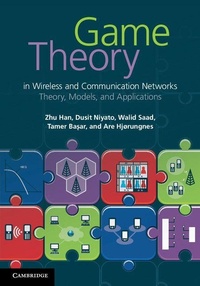
Game Theory in Wireless and Communication Networks
Theory, Models, and Applications
Published on 20. October 2011
Book
Hardback
554 pages
978-0-521-19696-3 (ISBN)
Description
This unified treatment of game theory focuses on finding state-of-the-art solutions to issues surrounding the next generation of wireless and communications networks. Future networks will rely on autonomous and distributed architectures to improve the efficiency and flexibility of mobile applications, and game theory provides the ideal framework for designing efficient and robust distributed algorithms. This book enables readers to develop a solid understanding of game theory, its applications and its use as an effective tool for addressing wireless communication and networking problems. The key results and tools of game theory are covered, as are various real-world technologies including 3G networks, wireless LANs, sensor networks, dynamic spectrum access and cognitive networks. The book also covers a wide range of techniques for modeling, designing and analysing communication networks using game theory, as well as state-of-the-art distributed design techniques. This is an ideal resource for communications engineers, researchers, and graduate and undergraduate students.
Reviews / Votes
'... a homogeneous collection of contributions in the field ... logically fluid, without an overwhelming load of formalism and axiomatic approaches that are, too often, offered by books on game theory aimed at engineers. We are convinced that the work will become a reference book for graduate students and network engineers interested in the design of future communication network protocols.' IEEE Communications MagazineMore details
Language
English
Place of publication
Cambridge
United Kingdom
Target group
Professional and scholarly
Illustrations
Worked examples or Exercises; 29 Tables, black and white; 107 Line drawings, unspecified
Dimensions
Height: 250 mm
Width: 175 mm
Thickness: 34 mm
Weight
1124 gr
ISBN-13
978-0-521-19696-3 (9780521196963)
Copyright in bibliographic data and cover images is held by Nielsen Book Services Limited or by the publishers or by their respective licensors: all rights reserved.
Schweitzer Classification
Other editions
Additional editions
Zhu Han | Dusit Niyato | Walid Saad
Game Theory in Wireless and Communication Networks
Theory, Models, and Applications
E-Book
03/2012
1st Edition
Cambridge University Press
€121.99
Available for download
E-Book
10/2011
Cambridge University Press
€102.99
Available for download
Persons
Zhu Han is an Assistant Professor of Electrical and Computer Engineering at the University of Houston. He was awarded his Ph.D. in Electrical Engineering from the University of Maryland, College Park, in 2003 and worked for two years in industry as an R&D Engineer for JDSD. Dusit Niyato is an Assistant Professor in the School of Computer Engineering at the Nanyang Technological University (NTU), Singapore. He received his Ph.D. in Electrical and Computer Engineering from the University of Manitoba, Canada, in 2008. Walid Saad is a Postdoctoral Research Associate in the Department of Electrical Engineering at Princeton University. He received his Ph.D. from the University of Oslo in 2010 and previously worked at several companies in the telecommunications and IT fields. Tamer Basar is a Swanlund Chair holder and CAS Professor of Electrical and Computer Engineering at the University of Illinois, Urbana-Champaign. He is a member of the US National Academy of Engineering, a Fellow of the IEEE and IFAC, founding president of the ISDG and current president of the AACC. Are Hjorungnes is a Professor in the Faculty of Mathematics and Natural Sciences at the University of Oslo, Norway. He is a Senior Member of the IEEE and received his Ph.D. from the Norwegian University of Science and Technology in 2000.
Content
1. Introduction; 2. Wireless networks: an introduction; Part I. Fundamentals of Game Theory: 3. Noncooperative games; 4. Bayesian games; 5. Differential games; 6. Evolutionary games; 7. Cooperative games; 8. Auction theory and mechanism design; Part II. Applications of Game Theory in Communications and Networking: 9. Cellular and broadband wireless access networks; 10. Wireless local area networks; 11. Multihop networks; 12. Cooperative transmission networks; 13. Cognitive radio networks; 14. Internet networks.