

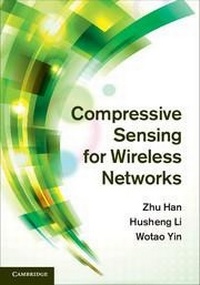
Compressive Sensing for Wireless Networks
Published on 6. June 2013
Book
Hardback
304 pages
978-1-107-01883-9 (ISBN)
Description
Compressive sensing is a new signal processing paradigm that aims to encode sparse signals by using far lower sampling rates than those in the traditional Nyquist approach. It helps acquire, store, fuse and process large data sets efficiently and accurately. This method, which links data acquisition, compression, dimensionality reduction and optimization, has attracted significant attention from researchers and engineers in various areas. This comprehensive reference develops a unified view on how to incorporate efficiently the idea of compressive sensing over assorted wireless network scenarios, interweaving concepts from signal processing, optimization, information theory, communications and networking to address the issues in question from an engineering perspective. It enables students, researchers and communications engineers to develop a working knowledge of compressive sensing, including background on the basics of compressive sensing theory, an understanding of its benefits and limitations, and the skills needed to take advantage of compressive sensing in wireless networks.
More details
Language
English
Place of publication
Cambridge
United Kingdom
Target group
Professional and scholarly
Product notice
sewn/stitched
Cloth over boards
Illustrations
Worked examples or Exercises; 7 Tables, black and white; 100 Line drawings, unspecified
Dimensions
Height: 255 mm
Width: 182 mm
Thickness: 22 mm
Weight
783 gr
ISBN-13
978-1-107-01883-9 (9781107018839)
Copyright in bibliographic data and cover images is held by Nielsen Book Services Limited or by the publishers or by their respective licensors: all rights reserved.
Schweitzer Classification
Other editions
Additional editions
E-Book
06/2013
Cambridge University Press
€102.99
Available for download
Zhu Han | Husheng Li | Wotao Yin
Compressive Sensing for Wireless Networks
E-Book
05/2013
1st Edition
Cambridge University Press
€121.99
Available for download
Persons
Zhu Han is an Associate Professor in the Electrical and Computer Engineering Department at the University of Houston, Texas. He received an NSF CAREER award in 2010 and the IEEE Fred W. Ellersick Prize in 2011. He co-authored papers that won the best paper award at the IEEE International Conference on Communications 2009, the 7th International Symposium on Modeling and Optimization in Mobile, Ad Hoc, and Wireless Networks (WiOpt09), and the IEEE Wireless Communication and Networking Conference, 2012. Husheng Li is an Assistant Professor in the Electrical and Computer Engineering Department at the University of Tennessee. He received the Best Paper Award of the EURASIP Journal on Wireless Communications and Networking in 2005 (together with his PhD advisor, Professor H. V. Poor), the Best Demo Award of IEEE Globecom in 2010, and the Best Paper Award at IEEE ICC in 2011. Wotao Yin is an Associate Professor at the Department of Computational and Applied Mathematics at Rice University. He won an NSF CAREER award in 2008 and an Alfred P. Sloan Research Fellowship in 2009.
Content
1. Introduction; 2. Overview of wireless networks; Part I. Compressive Sensing Techniques: 3. Compressive sensing framework; 4. Sparse optimization algorithms; Part II. Compressive Sensing-Based Wireless Communication: 5. Analog to digital converter; 6. Channel estimation; 7. Ultra wide band; 8. Positioning; 9. Multiple access; 10. Cognitive radio networks and sensor networks.