

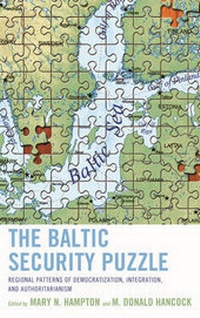
The Baltic Security Puzzle
Regional Patterns of Democratization, Integration, and Authoritarianism
Published on 22. October 2015
Book
Hardback
224 pages
978-1-4422-4852-6 (ISBN)
Description
International experts assess the components of the Baltic security puzzle by placing the security and political interests of the states of Latvia, Estonia, and Lithuania within the historical, economic, and political narratives of the greater Baltic region. They first reevaluate Baltic history as a progression of conflict, partial integration, Cold War division, up to today's efforts to build a security community. Next, they focus on economic and social relations by contrasting patterns of democratization, domestic politics, EU membership, and the economics of crime. Lastly, they analyze military security and evolving regional perceptions of threats as well as the dynamics of alliance behavior and the recent geostrategic clashes unearthed by Russia's behavior in Ukraine.
Reviews / Votes
The importance of the Baltic region for Europe's future remains undiminished. It is here where regional issues can quickly take on strategic relevance; where cooperation and confrontation lie close together; and where even the most dynamic political and economic developments have not yet managed to completely overcome a difficult historical legacy. In many respects, developments in the Baltic region will determine whether cooperation remains the hallmark of a European security order that in the wake of Russia's annexation of Crimea has come under strain. Above all, it may also be in the Baltic region where Russia's European vocation will be facing its ultimate test. The Baltic Security Puzzle explores the complex web of relations among the countries bordering the Baltic Sea, including their differing institutional alignments. It is a treasure trove of solid information and pertinent analysis, both for the expert as well as the interested general reader. -- Michael Ruehle, head, Energy Security Section, NATO Events in the Baltic region are a top concern in European capitals and in Washington. This timely book provides a balanced and cogent analysis of the complex political, economic, and military issues involved. A must read for anyone serious about understanding the security dimensions of this increasingly important and turbulent geographic region. -- Larry Valero, director, National Security Studies Institute, The University of Texas at El Paso A timely and essential look at the geopolitical puzzle of the Baltic Sea region. This comprehensive anthology explores both the relevant domestic factors and inter-regional tensions that define the little understood dynamics of this varied social, political, and economic space. A must read for those seeking to understand Russia's motives toward its Baltic neighbors and their efforts to develop and sustain Western institutions and identity. Hampton and Hancock fill a gaping void in European and Eurasian studies with this multi-dimensional analysis of the 9-nation Baltic region. -- Marybeth Ulrich, US Army War CollegeMore details
Language
English
Place of publication
United States
Publishing group
Bloomsbury Publishing Plc
Target group
Professional and scholarly
Dimensions
Height: 239 mm
Width: 157 mm
Thickness: 25 mm
Weight
544 gr
ISBN-13
978-1-4422-4852-6 (9781442248526)
Copyright in bibliographic data and cover images is held by Nielsen Book Services Limited or by the publishers or by their respective licensors: all rights reserved.
Schweitzer Classification
Other editions
Additional editions
Mary N. Hampton | M. Donald Hancock
The Baltic Security Puzzle
Regional Patterns of Democratization, Integration, and Authoritarianism
E-Book
10/2015
1st Edition
Rowman & Littlefield
€83.99
Available for download
Mary N. Hampton | M. Donald Hancock
The Baltic Security Puzzle
Regional Patterns of Democratization, Integration, and Authoritarianism
E-Book
10/2015
1st Edition
Rowman & Littlefield
€83.99
Available for download
Persons
Mary N. Hampton is professor of National Security and Director of Public Engagement at Air Command and Staff College, Air University, Maxwell AFB.
M. Donald Hancock is professor emeritus of political science at Vanderbilt University
Contributors:
Richard J. Bailey Jr. is Colonel in the USAF, dean of students and professor of Strategy and Security Studies, USAF School of Advanced Air and Space Studies, Maxwell AFB, Alabama
Mark Duckenfield is professor of international political economy in the Department of International Security Studies, Air War College, Air University, Maxwell AFB.
Roland Freudenstein is Head of Research and Deputy Director of the Brussels-based Wilfried Martens Centre for European Studies, the think tank of the European People's Party.
Dietmar Herz is chair for comparative government at the University of Erfurt, on leave from November 2009 to December 2015 to serve as Deputy Minister of Justice in the state of Thuringia.
Ursula Hoffmann-Lange is emeritus professor of political science at the University of Bamberg.
Mika Kerttunen, D.Soc.Sc. (Pol.), LTC (ret.) is Founder, and Research Director, Cyber Policy Institute (Tartu, Estonia).
Ramon Loik is vice-rector for research and development at the Estonian Academy of Security Sciences. He also lectures and supervises at Tartu University's Euro College.
Adam Nelson is a colonel in the Swedish Air Force.
Robert J. Smith, Jr. is Colonel in the USAF, director of staff and teaches in the Strategy and War department at Air War College, Air University, Maxwell AFB. He was recently the Dean of the Resident program, Air Command and Staff College, Air University, Maxwell AFB.
M. Donald Hancock is professor emeritus of political science at Vanderbilt University
Contributors:
Richard J. Bailey Jr. is Colonel in the USAF, dean of students and professor of Strategy and Security Studies, USAF School of Advanced Air and Space Studies, Maxwell AFB, Alabama
Mark Duckenfield is professor of international political economy in the Department of International Security Studies, Air War College, Air University, Maxwell AFB.
Roland Freudenstein is Head of Research and Deputy Director of the Brussels-based Wilfried Martens Centre for European Studies, the think tank of the European People's Party.
Dietmar Herz is chair for comparative government at the University of Erfurt, on leave from November 2009 to December 2015 to serve as Deputy Minister of Justice in the state of Thuringia.
Ursula Hoffmann-Lange is emeritus professor of political science at the University of Bamberg.
Mika Kerttunen, D.Soc.Sc. (Pol.), LTC (ret.) is Founder, and Research Director, Cyber Policy Institute (Tartu, Estonia).
Ramon Loik is vice-rector for research and development at the Estonian Academy of Security Sciences. He also lectures and supervises at Tartu University's Euro College.
Adam Nelson is a colonel in the Swedish Air Force.
Robert J. Smith, Jr. is Colonel in the USAF, director of staff and teaches in the Strategy and War department at Air War College, Air University, Maxwell AFB. He was recently the Dean of the Resident program, Air Command and Staff College, Air University, Maxwell AFB.
Content
Introduction: The Balticum in Comparative and International Perspective
Mary Hampton and M. Donald Hancock
PART I: Historical Context
Chapter 1: Waves of Conflict, Cooperation, and Tension in the Baltic Region
M. Donald Hancock
PART II: Economics and Society
Chapter 2: The Baltics and the Political Economy of Regional Integration
Mark Duckenfield
Chapter 3: Parties, Party Systems and Patterns of Governance
M. Donald Hancock, with assistance from Dietmar Herz
Chapter 4: Political Culture in the Baltic Region
Ursula Hoffmann-Lange
Chapter 5: Understanding European Security Integration: Fighting Criminal Interventions in the Baltic States
Ramon Loik with assistance from Robert Smith
PART III: Military Security
Chapter 6: Russia and the Baltics
Roland Freudenstein
Chapter 7: Unfinished Business: NATO Enlargement in the Baltic Sea Region
Mary Hampton
Chapter 8: The Future of Neutrality for Finland and Sweden
Mika Kertunnen
Chapter 9: Redefining the Struggle: Why the Baltics are Important to the Development of Strategic Thought Regarding Cyber Power
Rick Bailey
Chapter 10: The Special Case of Kaliningrad: Borderland Behavior and Identity
Robert Smith and Adam Nelson
Conclusion: Reflections on Politics, Policies, and Governance in the Baltic Sea Region and Beyond
M. Donald Hancock and Mary Hampton
Mary Hampton and M. Donald Hancock
PART I: Historical Context
Chapter 1: Waves of Conflict, Cooperation, and Tension in the Baltic Region
M. Donald Hancock
PART II: Economics and Society
Chapter 2: The Baltics and the Political Economy of Regional Integration
Mark Duckenfield
Chapter 3: Parties, Party Systems and Patterns of Governance
M. Donald Hancock, with assistance from Dietmar Herz
Chapter 4: Political Culture in the Baltic Region
Ursula Hoffmann-Lange
Chapter 5: Understanding European Security Integration: Fighting Criminal Interventions in the Baltic States
Ramon Loik with assistance from Robert Smith
PART III: Military Security
Chapter 6: Russia and the Baltics
Roland Freudenstein
Chapter 7: Unfinished Business: NATO Enlargement in the Baltic Sea Region
Mary Hampton
Chapter 8: The Future of Neutrality for Finland and Sweden
Mika Kertunnen
Chapter 9: Redefining the Struggle: Why the Baltics are Important to the Development of Strategic Thought Regarding Cyber Power
Rick Bailey
Chapter 10: The Special Case of Kaliningrad: Borderland Behavior and Identity
Robert Smith and Adam Nelson
Conclusion: Reflections on Politics, Policies, and Governance in the Baltic Sea Region and Beyond
M. Donald Hancock and Mary Hampton