

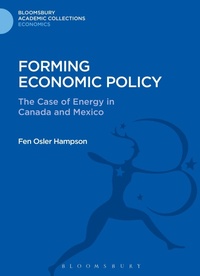
Forming Economic Policy
The Case of Energy in Canada and Mexico
Published on 7. November 2013
Book
Hardback
176 pages
978-1-4725-1174-4 (ISBN)
Description
How do governments make key decisions on vital economic questions of national
importance? Can they advance the national interest on issues that are highly
politicized? How do they respond to competing pressures from the international and
domestic environments?
Forming Economic Policy explores these and other questions in Canada and Mexico, two very different countries which share a common vulnerability to the world economy. Using the case of energy, the book argues that policymakers will address the national interest, but only episodically with the onset of major national crises that invoke a higher and sustained sense of national priorities. These crises are frequently induced by the interaction of domestic and foreign political and economic forces.
The conclusions are surprising. Despite profound political and economic differences between these two countries, policymakers have behaved in remarkably similar ways when arriving at key policy decisions. The explanation - which integrates two competing views of politics, the pluralist and the statist - has important implications with regard to the political processes in those states which, like Canada and Mexico, are exposed to the world economy and face problems of political legitimacy at home.
Forming Economic Policy will appeal to students and teachers of political economy and comparative politics as well as to those interested in the politics of energy policy.
importance? Can they advance the national interest on issues that are highly
politicized? How do they respond to competing pressures from the international and
domestic environments?
Forming Economic Policy explores these and other questions in Canada and Mexico, two very different countries which share a common vulnerability to the world economy. Using the case of energy, the book argues that policymakers will address the national interest, but only episodically with the onset of major national crises that invoke a higher and sustained sense of national priorities. These crises are frequently induced by the interaction of domestic and foreign political and economic forces.
The conclusions are surprising. Despite profound political and economic differences between these two countries, policymakers have behaved in remarkably similar ways when arriving at key policy decisions. The explanation - which integrates two competing views of politics, the pluralist and the statist - has important implications with regard to the political processes in those states which, like Canada and Mexico, are exposed to the world economy and face problems of political legitimacy at home.
Forming Economic Policy will appeal to students and teachers of political economy and comparative politics as well as to those interested in the politics of energy policy.
More details
Series
Language
English
Place of publication
London
United Kingdom
Publishing group
Bloomsbury Publishing PLC
Target group
College/higher education
Dimensions
Height: 240 mm
Width: 161 mm
Thickness: 14 mm
Weight
435 gr
ISBN-13
978-1-4725-1174-4 (9781472511744)
DOI
CBID179649
Copyright in bibliographic data and cover images is held by Nielsen Book Services Limited or by the publishers or by their respective licensors: all rights reserved.
Schweitzer Classification
Other editions
Additional editions
E-Book
11/2013
1st Edition
Bloomsbury Academic
€155.99
Available for download
Person
Fen Osler Hampson is Chancellor's Professor and Director of the Norman Paterson School of International Affairs (NPSIA), Carleton University, Canada.
Content
1. Introduction
2. How Crises Change Political Values
3. Micropolitics and Macropolitical Consequences in Mexico
4. Micropolitics and Macropolitical Consequences in Canada
5. Mexico's Energy Policies in the Seventies and Eighties: an Analysis
6. Canada's Energy Policies in the Seventies and Eighties: an Analysis
7. Conclusion
Bibliography
Index
2. How Crises Change Political Values
3. Micropolitics and Macropolitical Consequences in Mexico
4. Micropolitics and Macropolitical Consequences in Canada
5. Mexico's Energy Policies in the Seventies and Eighties: an Analysis
6. Canada's Energy Policies in the Seventies and Eighties: an Analysis
7. Conclusion
Bibliography
Index