

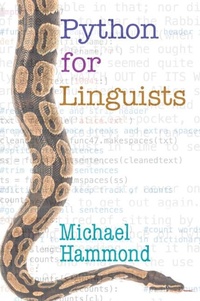
Python for Linguists
Published on 7. May 2020
Book
Paperback/Softback
310 pages
978-1-108-73707-4 (ISBN)
Description
Specifically designed for linguists, this book provides an introduction to programming using Python for those with little to no experience of coding. Python is one of the most popular and widely-used programming languages as it's also available for free and runs on any operating system. All examples in the text involve language data and can be adapted or used directly for language research. The text focuses on key language-related issues: searching, text manipulation, text encoding and internet data, providing an excellent resource for language research. More experienced users of Python will also benefit from the advanced chapters on graphical user interfaces and functional programming.
More details
Language
English
Place of publication
Cambridge
United Kingdom
Target group
Professional and scholarly
Product notice
Paperback (trade)
Illustrations
Worked examples or Exercises
Dimensions
Height: 229 mm
Width: 156 mm
Thickness: 20 mm
Weight
450 gr
ISBN-13
978-1-108-73707-4 (9781108737074)
Copyright in bibliographic data and cover images is held by Nielsen Book Services Limited or by the publishers or by their respective licensors: all rights reserved.
Schweitzer Classification
Other editions
Additional editions
Michael Hammond
Python for Linguists
Book
05/2020
Cambridge University Press
€129.50
Shipment within 15-20 days
Michael Hammond
Python for Linguists
E-Book
04/2020
Cambridge University Press
€31.49
Available for download
Person
Michael Hammond is Professor of Linguistics and Human Language Technology at the University of Arizona. His previous titles include Programming for Linguists: Perl for Language Professionals (2003) and Programming for Linguists: Java Technology for Language Professionals (2002).
Content
Preface; 1. Interacting with Python and basic functions; 2. Data types and variables; 3. Control structures; 4. Input-output; 5. Subroutines and modules; 6. Regular expressions; 7. Text manipulation; 8. Internet data; 9. Objects; 10. GUIs; 11. Functional programming; Appendix A. NLTK.