

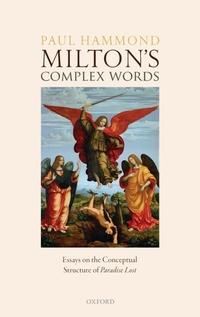
Milton's Complex Words
Essays on the Conceptual Structure of Paradise Lost
Published on 30. November 2017
Book
Hardback
498 pages
978-0-19-881011-7 (ISBN)
Description
Every major poet or philosopher develops their own distinctive semantic field around those terms which matter most to them, or which contribute most profoundly to the imagined world of a particular work. This book explores the specific meanings which Milton develops around key words in Paradise Lost.
Some of these are theological or philosophical terms (e.g. 'evil', 'grace', 'reason'); others are words which shape the imagined world of the poem (e.g. 'dark', 'fall', 'within'); yet others are small words or even prefixes which subtly move the argument in new directions (e.g. 'if', 'not', 're-'). Milton seems to expect his readers to be alert to the special semantic field which he creates around such words, often by infusing them with biblical and literary connotations, and activating their etymological roots; alert also to the patterns created by the repetitions of such words, and particularly to their diverse use (and often their blatant misuse) by different characters. To understand the migrations and malleability of key words is part of the education of Milton's reader.
Some of these are theological or philosophical terms (e.g. 'evil', 'grace', 'reason'); others are words which shape the imagined world of the poem (e.g. 'dark', 'fall', 'within'); yet others are small words or even prefixes which subtly move the argument in new directions (e.g. 'if', 'not', 're-'). Milton seems to expect his readers to be alert to the special semantic field which he creates around such words, often by infusing them with biblical and literary connotations, and activating their etymological roots; alert also to the patterns created by the repetitions of such words, and particularly to their diverse use (and often their blatant misuse) by different characters. To understand the migrations and malleability of key words is part of the education of Milton's reader.
Reviews / Votes
Milton's Complex Words prompts us to ask how detailed excavation of the linguistic riches of Paradise Lost can change our understanding of Milton's view of language ... Hammond leaves us to extrapolate our own conclusions from his elucidation of Paradise Lost as a beautifully intricate web of meaning suspended between multiple and varying usages of repeated terms, which bring with them into each individual occurrence the echoes of their other lives. * Hannah Crawforth, Milton Quarterly * For Miltonists, it offers a stimulating journey back through Milton's poem, with enough detail and elegant argument to be of interest. For students, it will be a good guide for understanding certain terms in Milton's oeuvre, with helpful suggestions for further study provided in the footnotes to each short chapter ... It may prove a welcome guide to those just entering, or even re-entering, the labyrinth of Paradise Lost. * Esther van Raamsdonk, Modern Language Review * "Milton's Complex Words brilliantly demonstrates Hammond's skills as a close reader, supremely attentive to how the varied definitions of his key words ... contributes to the meanings of Paradise Lost." -- Peter C. Herman, Modern PhilologyMore details
Language
English
Place of publication
Oxford
United Kingdom
Target group
College/higher education
Professional and scholarly
Dimensions
Height: 240 mm
Width: 161 mm
Thickness: 31 mm
Weight
907 gr
ISBN-13
978-0-19-881011-7 (9780198810117)
Copyright in bibliographic data and cover images is held by Nielsen Book Services Limited or by the publishers or by their respective licensors: all rights reserved.
Schweitzer Classification
Other editions
Additional editions
E-Book
11/2017
1st Edition
OUP eBook
€33.99
Available for download
E-Book
11/2017
1st Edition
OUP eBook
€33.99
Available for download
Person
Paul Hammond was educated at Peter Symonds' School, Winchester, and Trinity College, Cambridge, where he was a Prize Fellow in English. He is currently Professor of Seventeenth-Century English Literature at the University of Leeds. He was elected a Fellow of the British Academy in 2002.
Content
Preface
A Note on Texts and Abbreviations
1: Alone
2: Art
3: Chance, Fate, and Providence
4: Change
5: Choice
6: Dark and Light
7: Desire
8: Ease
9: Envy
10: Equal
11: Evil
12: Fall
13: Fancy and Reason
14: Free
15: God
16: Grace
17: Hope
18: I
19: Idol and Image
20: If and Perhaps
21: Knowledge and Wisdom
22: Love
23: Naked
24: New and Old
25: Not
26: Re-
27: See and Seem
28: Self-
29: Within
30: ?
Afterword
Bibliography
A Note on Texts and Abbreviations
1: Alone
2: Art
3: Chance, Fate, and Providence
4: Change
5: Choice
6: Dark and Light
7: Desire
8: Ease
9: Envy
10: Equal
11: Evil
12: Fall
13: Fancy and Reason
14: Free
15: God
16: Grace
17: Hope
18: I
19: Idol and Image
20: If and Perhaps
21: Knowledge and Wisdom
22: Love
23: Naked
24: New and Old
25: Not
26: Re-
27: See and Seem
28: Self-
29: Within
30: ?
Afterword
Bibliography