

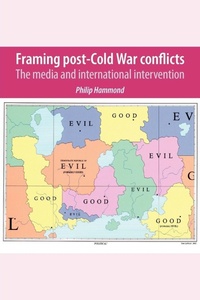
Framing Post-Cold War Conflicts
The Media and International Intervention
Published on 1. December 2011
Book
Paperback/Softback
256 pages
978-0-7190-8669-4 (ISBN)
Description
Since the end of the Cold War there have been many competing ideas about how to explain contemporary conflicts, and about how the West should respond to them. This study, newly available in paperback, examines how the media interpret conflicts and international interventions, testing the sometimes contradictory claims that have been made about recent coverage of war.
Framing post-Cold War conflicts takes a comparative approach, examining UK press coverage across six different crises. Through detailed analysis of news content, it seeks to identify the dominant themes in explaining the post-Cold War international order, and to discover how far the patterns established prior to 11 September 2001 have subsequently changed. Based on extensive original research, the book includes case studies of two 'humanitarian military interventions' (in Somalia and Kosovo), two instances where Western governments were condemned for not intervening enough (Bosnia and Rwanda), and the post-9/11 interventions in Afghanistan and Iraq. -- .
Framing post-Cold War conflicts takes a comparative approach, examining UK press coverage across six different crises. Through detailed analysis of news content, it seeks to identify the dominant themes in explaining the post-Cold War international order, and to discover how far the patterns established prior to 11 September 2001 have subsequently changed. Based on extensive original research, the book includes case studies of two 'humanitarian military interventions' (in Somalia and Kosovo), two instances where Western governments were condemned for not intervening enough (Bosnia and Rwanda), and the post-9/11 interventions in Afghanistan and Iraq. -- .
Reviews / Votes
'Shows via compelling empirical data and analyses that the United Kingdom's print media have systematically framed post-Cold war conflicts in ways that put their own governments and leaders in a favorable light. As these conflicts have almost invariably involved invading other and weaker countries, officials readily assume rights of aggression and a world of sovereign inequality; and so do the mainstream media. This is a valuable contribution both to media studies and the modalities of conflict in the age of "humanitarian intervention." 'Edward S. Herman, Professor Emeritus of Finance at the Wharton School, University of Pennsylvania and co-author with Noam Chomsky of Manufacturing Consent and The Political Economy of Human Rights -- .
More details
Language
English
Place of publication
Manchester
United Kingdom
Target group
College/higher education
Illustrations
Tables, black & white|Line drawings, black & white|Tables, colour
Dimensions
Height: 234 mm
Width: 156 mm
Thickness: 14 mm
Weight
395 gr
ISBN-13
978-0-7190-8669-4 (9780719086694)
Copyright in bibliographic data and cover images is held by Nielsen Book Services Limited or by the publishers or by their respective licensors: all rights reserved.
Schweitzer Classification
Other editions
Additional editions
E-Book
07/2018
1st Edition
Manchester University Press
from
€36.99
Available for download
Person
Philip Hammond is Reader in Media and Communication at London South Bank University. -- .
Content
Acknowledgements
Tables and charts
1. Introduction: post-Cold War conflicts and the media
2. Somalia, 1992-94
3. Bosnia, 1992-95
4. Rwanda, 1994
5. Kosovo, 1999
6. Afghanistan, 2001
7. Iraq, 2003
8. Conclusions: framing post-Cold War conflicts
Notes
References
Index -- .
Tables and charts
1. Introduction: post-Cold War conflicts and the media
2. Somalia, 1992-94
3. Bosnia, 1992-95
4. Rwanda, 1994
5. Kosovo, 1999
6. Afghanistan, 2001
7. Iraq, 2003
8. Conclusions: framing post-Cold War conflicts
Notes
References
Index -- .