

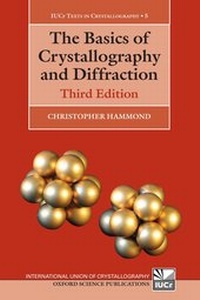
The Basics of Crystallography and Diffraction
Third Edition
3rd Edition
Published on 25. February 2009
Book
Hardback
450 pages
978-0-19-954644-2 (ISBN)
Description
This book provides a clear introduction to topics which are essential to students in a wide range of scientific disciplines but which are otherwise only covered in specialised and mathematically detailed texts. It shows how crystal structures may be built up from simple ideas of atomic packing and co-ordination, it develops the concepts of crystal symmetry, point and space groups by way of two dimensional examples of patterns and tilings, it explains the concept of the reciprocal lattice in simple terms and shows its importance in an understanding of light, X-ray and electron diffraction. Practical examples of the applications of these techniques are described and also the importance of diffraction in the performance of optical instruments. The book is also of value to the general reader since it shows, by biographical and historical references, how the subject has developed and thereby indicates some of the excitement of scientific discovery.
Reviews / Votes
This is a very well-established student text. Materials Characterization The Basics of Crystallography and Diffraction brings a lot of classical information together into one place, and presents it in a way acceptable to a modern audience. It is well-structured, carefully written and a pleasure to read. There should be a copy on the shelves of every crystallography laboratory. ACA RefleXions At almost 450 pages, this handsome book is ideal for any student or researcher who needs a basic understanding of crystallography and diffraction. The consistently high standard of presentation and explanation, the relatively low price (GBP30 for the paperback edition), and the fact that the book is now in its third edition tells you everything you need to know. [...] This book is recommended for students and researchers who need an introduction to crystallography that is clear, informative, easy to follow and an excellent read. Microscopy and Analysis I find it very easy to recommend this text, without any hesitation. The author's style of presentation is lucid and the book contains some excellent exercises to "stretch" the minds of students needing to acquire a facility with crystallography and diffraction. Materials Characterization The book is nicely illustrated and attractively produced. It is warmly recommended to all students and researchers in crystallography, including chemists, condensed-state physicists, materials scientists, and others who are interested in the structures of crystals and in how they are determined. Structural ChemistryMore details
Edition
3rd Revised edition
Language
English
Place of publication
Oxford
United Kingdom
Target group
College/higher education
Edition type
Revised edition
Illustrations
217 line drawings, 55 photographs
Dimensions
Height: 241 mm
Width: 163 mm
Thickness: 26 mm
Weight
893 gr
ISBN-13
978-0-19-954644-2 (9780199546442)
Copyright in bibliographic data and cover images is held by Nielsen Book Services Limited or by the publishers or by their respective licensors: all rights reserved.
Schweitzer Classification
Other editions
Additional editions
Book
02/2009
3rd Edition
Oxford University Press
€47.64
Article exhausted; check different version
Previous edition
Book
05/2001
2nd Edition
Oxford University Press
€137.42
Article exhausted; check for reprint
Person
Christopher Hammond is a Senior Lecturer at the Institute for Materials Research, at Leeds University, UK.
Content
1. Crystals and crystal structure ; 2. Two-dimensional patterns, lattices, and symmetry ; 3. Bravais lattices and crystal systems ; 4. Crystal symmetry, point groups, and crystal structures: the external symmetry of crystals ; 5. Describing lattice planes and directions in crystals: Miller indices and zone axis symbols ; 6. The reciprocal lattice ; 7. The diffraction of light ; 8. X-ray diffraction: The contributions of M. von Laue, W.H. and W.L. Bragg, and P.P. Ewald ; 9. The diffraction of X-rays and electrons ; 10. X-rays and electron diffraction of polycrystalline materials ; Appendix 1. Useful components for a crystallography model-building kit and suppliers ; Appendix 2. Computer programs in crystallography ; Appendix 3. Biographical notes on crystallographers and scientists mentioned in the text ; Appendix 4. Some useful crystallographic relationships ; Appendix 5. A simple introduction to vectors and complex numbers and their uses in crystallography ; Appendxix 6. Systematic absences (extinctions) in X-ray diffraction and double diffraction in electron diffraction patterns ; Answers to exercises ; Further reading ; Index