

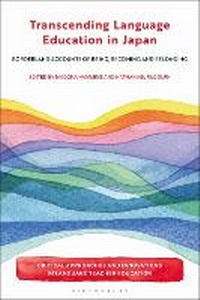
Transcending Language Education in Japan
Borderland Accounts of Being, Becoming, and Belonging
Published on 8. January 2026
Book
Hardback
232 pages
978-1-350-49719-1 (ISBN)
Description
This edited volume explores how language educators and other stakeholders wrestle with notions of being, becoming and belonging in and beyond educational spaces in Japan. The volume contends for critical, transformational approaches to "language education" to be contextualized, sociohistorically sensitive and community-based. As such, the volume challenges critically-oriented stakeholders in language teacher education to revisit how they conceptualize and approach identity, experience and injustice manifesting in communities and language education (including theory, research, teacher education, policy, curriculum, materials development, teaching, assessment and hiring practices). The volume serves as a catalyst for readers to revisit what frames their own "seeing," and as a foundation to engage with their own contexts and communities.
Reviews / Votes
'Japanese society is likely to be changing and the publication of this book is timely. These chapters reveal that Japan is not a homogeneous and monolingual country rather, it is a heterogeneous and multilingual one. Readers will listen to the voices of invisible minorities who have struggled to secure their personal and/or professional identities in Japan and beyond.' * Masahide Ishihara, University of the Ryukyus, Japan *More details
Series
Language
English
Place of publication
London
United Kingdom
Publishing group
Bloomsbury Publishing PLC
Target group
Professional and scholarly
College/higher education
Product notice
Laminated cover
Illustrations
10 bw illus
Dimensions
Height: 234 mm
Width: 156 mm
Thickness: 14 mm
Weight
502 gr
ISBN-13
978-1-350-49719-1 (9781350497191)
Copyright in bibliographic data and cover images is held by Nielsen Book Services Limited or by the publishers or by their respective licensors: all rights reserved.
Schweitzer Classification
Persons
Madoka Hammine is Assistant Professor in the College of Arts, Humanities, and Social Sciences at the University of Denver, Colorado
Nathanael Rudolph is Professor of sociolinguistics and language education at Kindai University in Higashiosaka, Japan
Nathanael Rudolph is Professor of sociolinguistics and language education at Kindai University in Higashiosaka, Japan
Content
Foreword, John C. Maher (International Christian University, Japan)
Introduction, Madoka Hammine (Meio University, Japan) and Nathanael Rudolph (Kindai University, Japan)
1. Forging "Uneasy Alliances" through Multi-Scalar Networks of being "Japanese": Minority, Colonizer, and Outsider Positionalities of a Researcher-Educator, Neriko Doerr (Ramapo College, Japan)
2. Why Do I Have Mixed and Confusing Feelings about Japaneseness?: Reflecting on 20 Years of Teaching as a JFL Teacher, Saeri Yamamoto (Yamaguchi University, Japan)
3. ??????????????:??????????????????? (How Japanese am I? - Reflecting on Borders and Borderlines of "Japanese" in Myself), Kimiko Suzuki (Haverford College, USA)
4. Language, Identity, and Empowerment: A Zainichi Korean's Perspective, Jisuk Park (University of Toronto, Canada)
5. ???????????????????????? (Inter-School Community Mobility and Ethnic Identity Formation), Aena Noh (Kindai University, Japan)
6. The Linguistic Shift in a Language Island: Changes in the Community through a Research and Language Revitalization Project, Joy Taniguchi (Shizuoka Institute of Science and Technology, Japan)
7. Love and Hope in the Face of Darkness: Teaching and Training in Children's Homes in Japan, Kanako Ishida and Nathanael Rudolph (Kindai University, Japan)
8. Yaeyamanness, Okinawanness and Japaneseness in Japan - A Duoethnographic Inquiry from Yaeyaman Language Revitalization, Madoka Hammine (Meio University, Japan) and Masami Hanashiro (School Teacher Emeritus)
9. Indigeneity and Identity: Who is/are Indigenous Amami?, Satoru Nakagawa (University of Manitoba, Canada)
10. Ainu Language Reclamation through Te Ataarangi Method: Nurturing New Ainu Speakers, Silja Ijas (Hokkaido University, Japan) and Kenji Sekine (Biratori Town Board of Education, Department of Lifelong Learning)
11. Revealing and Retelling Japan and Japaneseness through the Way English Is Taught: Scrutinizing Accounts of Encounters of an Identifying Nature, Glenn Toh (Nanyang Technological University, Singapore)
12. An Autoethnography of Ungovernable Self: Encountering Language-Capturing Apparatus in the English Education Industry in Japan , Xinqi He (Rikkyo University, Japan)
Conclusion, Madoka Hammine (Meio University, Japan) and Nathanael Rudolph (Kindai University, Japan)
References
Index
Introduction, Madoka Hammine (Meio University, Japan) and Nathanael Rudolph (Kindai University, Japan)
1. Forging "Uneasy Alliances" through Multi-Scalar Networks of being "Japanese": Minority, Colonizer, and Outsider Positionalities of a Researcher-Educator, Neriko Doerr (Ramapo College, Japan)
2. Why Do I Have Mixed and Confusing Feelings about Japaneseness?: Reflecting on 20 Years of Teaching as a JFL Teacher, Saeri Yamamoto (Yamaguchi University, Japan)
3. ??????????????:??????????????????? (How Japanese am I? - Reflecting on Borders and Borderlines of "Japanese" in Myself), Kimiko Suzuki (Haverford College, USA)
4. Language, Identity, and Empowerment: A Zainichi Korean's Perspective, Jisuk Park (University of Toronto, Canada)
5. ???????????????????????? (Inter-School Community Mobility and Ethnic Identity Formation), Aena Noh (Kindai University, Japan)
6. The Linguistic Shift in a Language Island: Changes in the Community through a Research and Language Revitalization Project, Joy Taniguchi (Shizuoka Institute of Science and Technology, Japan)
7. Love and Hope in the Face of Darkness: Teaching and Training in Children's Homes in Japan, Kanako Ishida and Nathanael Rudolph (Kindai University, Japan)
8. Yaeyamanness, Okinawanness and Japaneseness in Japan - A Duoethnographic Inquiry from Yaeyaman Language Revitalization, Madoka Hammine (Meio University, Japan) and Masami Hanashiro (School Teacher Emeritus)
9. Indigeneity and Identity: Who is/are Indigenous Amami?, Satoru Nakagawa (University of Manitoba, Canada)
10. Ainu Language Reclamation through Te Ataarangi Method: Nurturing New Ainu Speakers, Silja Ijas (Hokkaido University, Japan) and Kenji Sekine (Biratori Town Board of Education, Department of Lifelong Learning)
11. Revealing and Retelling Japan and Japaneseness through the Way English Is Taught: Scrutinizing Accounts of Encounters of an Identifying Nature, Glenn Toh (Nanyang Technological University, Singapore)
12. An Autoethnography of Ungovernable Self: Encountering Language-Capturing Apparatus in the English Education Industry in Japan , Xinqi He (Rikkyo University, Japan)
Conclusion, Madoka Hammine (Meio University, Japan) and Nathanael Rudolph (Kindai University, Japan)
References
Index