

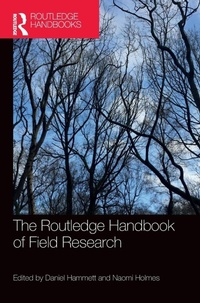
The Routledge Handbook of Field Research
1st Edition
Published on 28. July 2025
Book
Hardback
546 pages
978-1-032-52018-6 (ISBN)
Description
The Routledge Handbook of Field Research presents a comprehensive, go-to resource for staff and students in preparing for and thinking about the doing of field research, including both individual fieldwork and group field classes.
Framed by rapidly evolving debates relating to environmental and social justice, decolonialism, the climate crisis, and post-truth society, as well as taking into account ethical, health and safety, and other practical considerations, researchers are faced with a complex and evolving set of factors when making decisions. Working from foundational questions relating to the need for and importance of field research, of where the 'field' is, through logistical and practical concerns, to complex debates around equality and diversity, power relations, sustainability and ethical conundrums, this book is not a simple, formulaic 'how to' guide. Instead, the handbook offers a more critical and reflective approach - acting more as a 'how to start to think critically about' text. In providing a comprehensive and cutting-edge overview of key debates and considerations in the planning, doing, and wrapping up of field research, the handbook shares examples and reflections from experienced field researchers and field class leaders as well as scenarios, debates, and critical questions to help guide field researchers through their research journey. While there is a rapidly expanding array of books on research methods and epistemologies, this handbook offers a unique contribution that addresses distinct gaps in the current literature. Through a strong emphasis on field class and group-based field research, this handbook offers a unique resource to support field class leaders in thinking through the design and doing of field classes, and adopts a pedagogical approach in 'asking difficult questions' of the reader rather than offering 'the answer'. In so doing, we promote a deeper, reflective engagement with the complexities of the research journey.
The Routledge Handbook of Field Research includes contributions from over 50 leading authors, culminating in an essential resource for both experienced field researchers and field class leaders as well as newcomers to lone and group-based field research.
Framed by rapidly evolving debates relating to environmental and social justice, decolonialism, the climate crisis, and post-truth society, as well as taking into account ethical, health and safety, and other practical considerations, researchers are faced with a complex and evolving set of factors when making decisions. Working from foundational questions relating to the need for and importance of field research, of where the 'field' is, through logistical and practical concerns, to complex debates around equality and diversity, power relations, sustainability and ethical conundrums, this book is not a simple, formulaic 'how to' guide. Instead, the handbook offers a more critical and reflective approach - acting more as a 'how to start to think critically about' text. In providing a comprehensive and cutting-edge overview of key debates and considerations in the planning, doing, and wrapping up of field research, the handbook shares examples and reflections from experienced field researchers and field class leaders as well as scenarios, debates, and critical questions to help guide field researchers through their research journey. While there is a rapidly expanding array of books on research methods and epistemologies, this handbook offers a unique contribution that addresses distinct gaps in the current literature. Through a strong emphasis on field class and group-based field research, this handbook offers a unique resource to support field class leaders in thinking through the design and doing of field classes, and adopts a pedagogical approach in 'asking difficult questions' of the reader rather than offering 'the answer'. In so doing, we promote a deeper, reflective engagement with the complexities of the research journey.
The Routledge Handbook of Field Research includes contributions from over 50 leading authors, culminating in an essential resource for both experienced field researchers and field class leaders as well as newcomers to lone and group-based field research.
More details
Language
English
Place of publication
London
United Kingdom
Publishing group
Taylor & Francis Ltd
Target group
College/higher education
Professional and scholarly
Academic, Postgraduate, Professional Practice & Development, and Undergraduate Advanced
Illustrations
15 s/w Abbildungen, 9 s/w Photographien bzw. Rasterbilder, 6 s/w Zeichnungen, 11 s/w Tabellen
11 Tables, black and white; 6 Line drawings, black and white; 9 Halftones, black and white; 15 Illustrations, black and white
Dimensions
Height: 250 mm
Width: 175 mm
Thickness: 35 mm
Weight
1150 gr
ISBN-13
978-1-032-52018-6 (9781032520186)
Copyright in bibliographic data and cover images is held by Nielsen Book Services Limited or by the publishers or by their respective licensors: all rights reserved.
Schweitzer Classification
Other editions
Additional editions
Daniel Hammett | Naomi Holmes
The Routledge Handbook of Field Research
E-Book
07/2025
Routledge
€68.49
Available for download
Daniel Hammett | Naomi Holmes
The Routledge Handbook of Field Research
E-Book
07/2025
Routledge
€68.49
Available for download
Persons
Daniel Hammett, School of Geography and Planning, University of Sheffield, UK, and Department of Geography, Environmental Management and Energy Studies, University of Johannesburg, South Africa
Naomi Holmes, Department of Education, University of York, UK, and Department of Environment and Geography, University of York, UK
Naomi Holmes, Department of Education, University of York, UK, and Department of Environment and Geography, University of York, UK
Content
Introduction: Why doing field-research well matters Part I: Shifting Landscapes of Field Research Part II: Developing Inclusive Field Research Part III: Planning and Preparing Field Research Part IV: Negotiating Field Research in Practice Part V: Field Research Methods in Practice Part VI: Legacies and Afterlives of Field Research Part VII Looking Ahead