

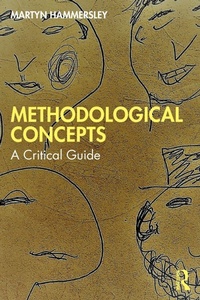
Methodological Concepts
A Critical Guide
1st Edition
Published on 21. February 2023
Book
Paperback/Softback
176 pages
978-1-032-39574-6 (ISBN)
Description
Methodological Concepts: A Critical Guide clarifies many key terms and issues in social research methodology. It outlines the conventional meanings of these terms, but also addresses their contentious character. The aim is to offer interpretations of them that provide a coherent conception of the nature of social science.
This book is premised on the idea that more clarity about the meaning of major methodological concepts is essential, and that the disagreements which pervade the field must be addressed. Numerous key terms are discussed across 13 chapters, including 'methodology', 'method', 'inquiry', 'research', 'science', 'truth', 'fact', 'rigour', 'bias', 'objectivity', 'data', 'evidence', 'induction', 'deduction', 'abduction', 'understanding', 'explanation', 'reflexivity', 'triangulation', 'theory', and 'researcher integrity'. These concepts have been implicated in fundamental divisions among social scientists, exemplified by the 'paradigm wars' of the past few decades. The chapters of this book provide an overview of the various meanings given to these terms, whilst also offering distinctive interpretations designed to provide a sound basis for social research.
Methodological Concepts: A Critical Guide will be of great use to any student or researcher working in the social sciences.
This book is premised on the idea that more clarity about the meaning of major methodological concepts is essential, and that the disagreements which pervade the field must be addressed. Numerous key terms are discussed across 13 chapters, including 'methodology', 'method', 'inquiry', 'research', 'science', 'truth', 'fact', 'rigour', 'bias', 'objectivity', 'data', 'evidence', 'induction', 'deduction', 'abduction', 'understanding', 'explanation', 'reflexivity', 'triangulation', 'theory', and 'researcher integrity'. These concepts have been implicated in fundamental divisions among social scientists, exemplified by the 'paradigm wars' of the past few decades. The chapters of this book provide an overview of the various meanings given to these terms, whilst also offering distinctive interpretations designed to provide a sound basis for social research.
Methodological Concepts: A Critical Guide will be of great use to any student or researcher working in the social sciences.
More details
Language
English
Place of publication
London
United Kingdom
Publishing group
Taylor & Francis Ltd
Target group
College/higher education
Postgraduate and Undergraduate Advanced
Illustrations
1 s/w Tabelle
1 Tables, black and white
Dimensions
Height: 234 mm
Width: 156 mm
Thickness: 10 mm
Weight
295 gr
ISBN-13
978-1-032-39574-6 (9781032395746)
Copyright in bibliographic data and cover images is held by Nielsen Book Services Limited or by the publishers or by their respective licensors: all rights reserved.
Schweitzer Classification
Other editions
Additional editions
Book
02/2023
1st Edition
Routledge
€185.80
Shipment within 10-20 days
E-Book
02/2023
1st Edition
Routledge
€48.49
Available for download
E-Book
02/2023
1st Edition
Routledge
€48.49
Available for download
Person
Martyn Hammersley is Emeritus Professor of Educational and Social Research at The Open University, UK. His research interests include the sociology of education, the sociology of the media, ethnography, and social research methodology. He is the author of numerous books, including The Politics of Social Research (1995), Reading Ethnographic Research (Second edition, 1997), Educational Research, Policymaking and Practice (2002), Questioning Qualitative Inquiry (2008), The Myth of Research-Based Policy and Practice (2013), The Limits of Social Science (2014), The Radicalism of Ethnomethodology (2018), Ethnography: Principles in Practice (Fourth edition, Routledge, 2019), The Concept of Culture (2019), and Troubling Sociological Concepts (2020).
Content
Introduction 1. Methodology and method 2. Inquiry, research, and science 3. Truth 4. Fact 5. Bias and objectivity 6. Rigour 7. Data and evidence 8. Deduction, induction, and abduction 9. Understanding and explanation 10. Reflexivity 11. Triangulation 12. Theory 13. Researcher integrity References Glossary of philosophical terms