

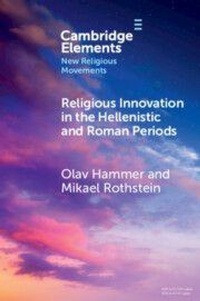
Religious Innovation in the Hellenistic and Roman Periods
Published on 10. August 2023
Book
Paperback/Softback
78 pages
978-1-009-01525-7 (ISBN)
Description
The scholarly study of new religious movements focuses on the contemporary period, but religious innovation is nothing new. This Element explores a historical epoch characterized by a multitude of emergent religious concepts and practices - the Hellenistic and Roman periods. A precondition for the intense degree of religious innovation during this time was a high level of cultural exchange. Religious elements crossed porous cultural borders and were adapted to suit new purposes. The resulting amalgams were presented in a vast corpus of texts, largely produced by a literate elite. Charismatic leaders played a particularly important role in creating new religious options and were described in genres that were infused with ideological agendas. Novel religious developments were accepted by the Roman authorities unless suspected of undermining the social order. The rise of one of the many new religions of the period, Christianity, ultimately changed the religious landscape in profound ways.
More details
Series
Language
English
Place of publication
Cambridge
United Kingdom
Target group
College/higher education
Product notice
Paperback (trade)
Illustrations
Worked examples or Exercises
Dimensions
Height: 229 mm
Width: 152 mm
Thickness: 4 mm
Weight
118 gr
ISBN-13
978-1-009-01525-7 (9781009015257)
Copyright in bibliographic data and cover images is held by Nielsen Book Services Limited or by the publishers or by their respective licensors: all rights reserved.
Schweitzer Classification
Other editions
Additional editions
Olav Hammer | Mikael Rothstein
Religious Innovation in the Hellenistic and Roman Periods
E-Book
08/2023
Cambridge University Press
€22.49
Available for download
Olav Hammer | Mikael Rothstein
Religious Innovation in the Hellenistic and Roman Periods
E-Book
08/2023
Cambridge University Press
€22.49
Available for download
Persons
Content
1. Introduction; 2. A world of regional globalization; 3. Religious texts; 4. Holy men, charismatic leaders, and religious entrepreneurs; 5. Conflict, concord, and religious polemics; References.