

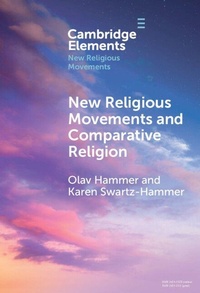
New Religious Movements and Comparative Religion
Published on 22. February 2024
Book
Hardback
80 pages
978-1-009-50074-6 (ISBN)
Description
This Element provides an introduction to a number of less frequently explored approaches based upon the comparative study of religions. New religions convey origin myths, present their particular views of history, and craft Endtime scenarios. Their members carry out a vast and diverse array of ritual activities. They produce large corpuses of written texts and designate a subset of these as a sacrosanct canon. They focus their attention on material objects that can range from sacred buildings to objects from the natural world that are treated in ritualized fashion. The reason for this fundamental similarity between older and newer religions is briefly explored in terms of the cognitive processes that underlie religious concepts and practices. A final section returns to the issue of how such shared processes take specific shapes in the context of modern, Western societies.
More details
Series
Language
English
Place of publication
Cambridge
United Kingdom
Product notice
sewn/stitched
Cloth over boards
Illustrations
Worked examples or Exercises
Dimensions
Height: 229 mm
Width: 152 mm
Thickness: 6 mm
Weight
281 gr
ISBN-13
978-1-009-50074-6 (9781009500746)
Copyright in bibliographic data and cover images is held by Nielsen Book Services Limited or by the publishers or by their respective licensors: all rights reserved.
Schweitzer Classification
Other editions
Additional editions
Olav Hammer | Karen Swartz
New Religious Movements and Comparative Religion
E-Book
02/2024
Cambridge University Press
€20.99
Available for download
Olav Hammer | Karen Swartz
New Religious Movements and Comparative Religion
E-Book
02/2024
Cambridge University Press
€20.99
Available for download
Olav Hammer | Karen Swartz
New Religious Movements and Comparative Religion
Book
02/2024
Cambridge University Press
€24.00
Shipment within 15-20 days
Persons
Content
1. Introduction; 2. Myths; 3. Rituals; 4. Material objects in new religious movements; 5. Texts; 6. New religions in comparative perspective; References.