

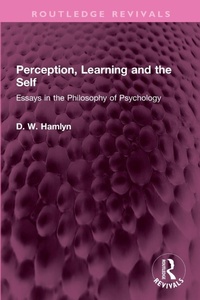
Perception, Learning and the Self
Essays in the Philosophy of Psychology
1st Edition
Published on 1. June 2024
Book
Paperback/Softback
324 pages
978-1-032-32180-6 (ISBN)
Description
First published in 1983, Perception, Learning and the Self is a collection of essays demonstrating the incompleteness of the information-processing model in cognitive psychology and the connection between epistemic factors and social conditions in the making of the self. It is suggested that any framework employed to view cognition must be an essentially social one, in which knowers are seen as selves who are agents with feelings and attitudes. Professor Hamlyn argues that, by failing to acknowledge this social element, the information-processing model presents an overly simplistic view of the systems that underlie cognition, and thus is liable to distort what is at stake. Professor Hamlyn considers the contributions of a number of major psychologists to this area of study, including James Gibson, Jean Piaget and Sigmund Freud. This book will be of interest to students of philosophy and psychology.
More details
Series
Language
English
Place of publication
London
United Kingdom
Publishing group
Taylor & Francis Ltd
Target group
College/higher education
Postgraduate
Product notice
Paperback (trade)
Dimensions
Height: 234 mm
Width: 156 mm
Thickness: 17 mm
Weight
457 gr
ISBN-13
978-1-032-32180-6 (9781032321806)
Copyright in bibliographic data and cover images is held by Nielsen Book Services Limited or by the publishers or by their respective licensors: all rights reserved.
Schweitzer Classification
Other editions
Additional editions
E-Book
06/2022
1st Edition
Routledge
€44.99
Available for download
E-Book
06/2022
1st Edition
Routledge
€44.99
Available for download

Book
06/2022
1st Edition
Routledge
€187.80
Shipment within 10-20 days
Content
Preface and acknowledgements Introduction 1. Unconscious inference and judgment in perception 2. The concept of information in Gibson's theory of perception 3. Perception and agency 4. Perception, information, and attention 5. The logical and psychological aspects of learning 6. Conditioning and behaviour 7. Epistemology and conceptual development 8. Human learning 9. The concept of development 10. What exactly is social about the origins of understanding? 11. Unconscious intentions 12. Self-deception 13. Person-perception and our understanding of others 14. Self-knowledge 15. The phenomena of love and hate 16. Learning to love Epilogue Index