

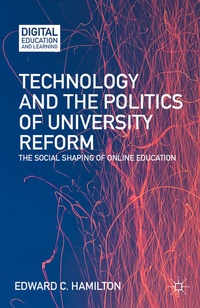
Technology and the Politics of University Reform
Description
Do new technologies mean the end of the university as we know it? Or can they be shaped in a way that balances innovation and tradition? This volume explores these questions through a critical history of online education.
Reviews / Votes
"Most histories of technology trace progress from primitive beginnings to contemporary achievements. Not this extraordinary book. Applying the methods of Science and Technology Studies, Hamilton depicts the history of online education as a conflict over the nature of education embodied in a variety of sociotechnical systems. These systems are distinguished by the philosophy of education they support. Will education adapt to technology or will it adapt technology? That question divides the alternatives. Hamilton's main purpose is to explain the origins and development of that divide, but in the process he explains clearly and convincingly why and how higher education can integrate the Internet while resisting the 'evangelical discourse' of automation." (Andrew Feenberg, Author of Questioning Technology)
"We are now a number of decades into the so-called digital revolution, and university campuses have hardly become the'relics' some had predicted. In this sophisticated and perceptive study, Hamilton provides a compelling account of socio-technical change and contention in academia. He begins by returning to the heady 'dot-com' days of the 1990s to understand much more recent developments --such as MOOCs and blended learning-- as a complex contestation of social forces. As Hamilton makes clear, these forces include not only technology itself, but also capital, management priorities, and significantly, teacher and student agency. An important and impressively intelligent book!" (Norm Friesen, Associate Professor of Educational Technology, Boise State University, USA)
More details
Other editions
Additional editions
Person
Edward C. Hamilton is Chair of the School of Communication at Capilano University, Canada.
Content
1. Online Education and the Politics of Technology
2. From Constructivism to Normative Critique: Technology, History and Politics
3. The Age of Automation: The Technical Code of Online Education to 1980
4. The Age of Ambivalence: Early Experiments in Educational Computer Conferencing
5. The Age of Evangelism: From Online Education to the Virtual University
6. The Age of Openness: From Critical Interventions to the Encoding of Online Education
7. The Ambivalence of Openness: MOOCs and the Critical Practice of Online Education