

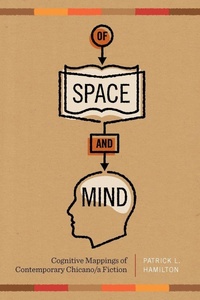
Of Space and Mind
Cognitive Mappings of Contemporary Chicano/a Fiction
Published on 1. April 2011
Book
Paperback/Softback
224 pages
978-0-292-74397-7 (ISBN)
Description
Chicano/a fiction is often understood as a literature of resistance to the dominant U.S. Anglo culture and society. But reducing this rich literary production to a single, binary opposition distorts it in fundamental ways. It conflates literature with life, potentially substituting a literature of protest for social activism that could provoke real changes in society. And it overlooks the complex range of responses to Anglo society that actually animates Chicano/a fiction.
In this paradigm-shifting book, Patrick L. Hamilton analyzes works by Rudolfo Anaya, Ana Castillo, Denise ChAvez, Rolando Hinojosa, Arturo Islas, John Rechy, Alfredo VEa, and Helena MarIa Viramontes to expand our understandings of the cultural interactions within the United States that are communicated by Chicano/a fiction. He argues that the narrative ethics of "resistance" within the Chicano/a canon is actually complemented by ethics of "persistence" and "transformation" that imagine cultural differences within the United States as participatory and irreducible to simple oppositions. To demonstrate these alternative ethics, Hamilton adapts the methodology of cognitive mapping; that is, he treats the chosen fictional texts as mental maps that are constructed around and communicative of the narrative's ethics. As he reads these cognitive maps, which envision Chicano/a culture as being part of U.S. society rather than as "resistant" and separate, Hamilton asserts that the authors' conception of cultural difference speaks more usefully to current sociopolitical debates, such as those about gay marriage and immigration reform, than does the traditional "resistant" paradigm.
In this paradigm-shifting book, Patrick L. Hamilton analyzes works by Rudolfo Anaya, Ana Castillo, Denise ChAvez, Rolando Hinojosa, Arturo Islas, John Rechy, Alfredo VEa, and Helena MarIa Viramontes to expand our understandings of the cultural interactions within the United States that are communicated by Chicano/a fiction. He argues that the narrative ethics of "resistance" within the Chicano/a canon is actually complemented by ethics of "persistence" and "transformation" that imagine cultural differences within the United States as participatory and irreducible to simple oppositions. To demonstrate these alternative ethics, Hamilton adapts the methodology of cognitive mapping; that is, he treats the chosen fictional texts as mental maps that are constructed around and communicative of the narrative's ethics. As he reads these cognitive maps, which envision Chicano/a culture as being part of U.S. society rather than as "resistant" and separate, Hamilton asserts that the authors' conception of cultural difference speaks more usefully to current sociopolitical debates, such as those about gay marriage and immigration reform, than does the traditional "resistant" paradigm.
More details
Series
Language
English
Place of publication
Austin, TX
United States
Target group
Professional and scholarly
Product notice
Paperback (trade)
Dimensions
Height: 229 mm
Width: 152 mm
Thickness: 13 mm
Weight
374 gr
ISBN-13
978-0-292-74397-7 (9780292743977)
Copyright in bibliographic data and cover images is held by Nielsen Book Services Limited or by the publishers or by their respective licensors: all rights reserved.
Schweitzer Classification
Person
Patrick L. Hamilton is Professor of English at Misericordia University.
Content
Acknowledgments
Introduction: Toward New Mappings of Contemporary Chicano/a Fiction
Chapter 1: Mapping Resistance in Rudolfo Anaya's Bless Me, Ultima and Rolando Hinojosa's "Sometimes It Just Happens That Way; That's All"
Chapter 2: Mapping Persistence in John Rechy's The Miraculous Day of Amalia GOmez and Helena MarIa Viramontes's "The Cariboo CafE"
Chapter 3: Cosmopolitan Communities in Alfredo VEa's La Maravilla and Ana Castillo's So Far from God
Chapter 4: Changing Minds in Ana Castillo's Sapogonia and Arturo Islas's La Mollie and the King of Tears
Chapter 5: The Transformative Spaces of Alfredo VEa's The Silver Cloud CafE and Gods Go Begging
Conclusion
Notes
Works Cited
Index
Introduction: Toward New Mappings of Contemporary Chicano/a Fiction
Chapter 1: Mapping Resistance in Rudolfo Anaya's Bless Me, Ultima and Rolando Hinojosa's "Sometimes It Just Happens That Way; That's All"
Chapter 2: Mapping Persistence in John Rechy's The Miraculous Day of Amalia GOmez and Helena MarIa Viramontes's "The Cariboo CafE"
Chapter 3: Cosmopolitan Communities in Alfredo VEa's La Maravilla and Ana Castillo's So Far from God
Chapter 4: Changing Minds in Ana Castillo's Sapogonia and Arturo Islas's La Mollie and the King of Tears
Chapter 5: The Transformative Spaces of Alfredo VEa's The Silver Cloud CafE and Gods Go Begging
Conclusion
Notes
Works Cited
Index