

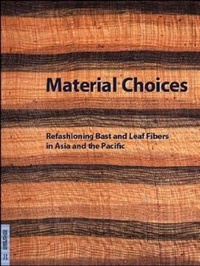
Material Choices
Refashioning Bast and Leaf Fibers in Asia and the Pacific
Will be published approx. on 7. November 2007
Book
Paperback/Softback
188 pages
978-0-9748729-8-8 (ISBN)
Description
Winner of the R. L. Shep Ethnic Textiles Award sponsored by the Textile Society of America
Asia is renowned for the production of fine handwoven cottons and luxurious silks -- important items of trade for centuries. In addition to these celebrated fabrics, however, weavers throughout the region produced cloth from ramie, hemp, pina, and banana fibers (including Philippine abaca and Okinawan ito basho), as well as a number of lesser-known plant fibers. Over the course of the twentieth century, many of these Asian plant fiber weaving traditions became marginalized or hovered on the brink of extinction, given the advent of synthetic fabrics, growing industrialization, and increased international textile trade. As the essays in this book testify, however, they have not vanished altogether. Rather, in recent times weavers have purposefully chosen to pursue various efforts directed at their preservation, revival, or reinvention. In many cases, the production of bast and leaf fiber textiles is now thriving in newly globalized situations.
This volume presents eight essays documenting the current state of bast and leaf fiber weaving traditions in Vietnam, Borneo, Korea, Burma, Okinawa, the Philippines, Japan, and Micronesia. The processes that have nurtured or buffeted attempts to preserve or revive the production of these textiles are examined and abundantly illustrated with color photographs.
Asia is renowned for the production of fine handwoven cottons and luxurious silks -- important items of trade for centuries. In addition to these celebrated fabrics, however, weavers throughout the region produced cloth from ramie, hemp, pina, and banana fibers (including Philippine abaca and Okinawan ito basho), as well as a number of lesser-known plant fibers. Over the course of the twentieth century, many of these Asian plant fiber weaving traditions became marginalized or hovered on the brink of extinction, given the advent of synthetic fabrics, growing industrialization, and increased international textile trade. As the essays in this book testify, however, they have not vanished altogether. Rather, in recent times weavers have purposefully chosen to pursue various efforts directed at their preservation, revival, or reinvention. In many cases, the production of bast and leaf fiber textiles is now thriving in newly globalized situations.
This volume presents eight essays documenting the current state of bast and leaf fiber weaving traditions in Vietnam, Borneo, Korea, Burma, Okinawa, the Philippines, Japan, and Micronesia. The processes that have nurtured or buffeted attempts to preserve or revive the production of these textiles are examined and abundantly illustrated with color photographs.
Reviews / Votes
"This book goes on a voyage through a variety of thought-provoking issues relating to marginal fibre artefacts across the remote areas of the Asia-Pacific region.... The anthropological approaches adopted in this book have much to offer textile and dress historians seeking broader perspectives in order to understand objects. In addition, this volume is lavishly illustrated throughout, providing inspiration for anyone with an interest in the processes of fibre production as wel as the woven textiles they create."(Textile History) "Material Choices is another fine contribution to the proliferating field of material culture studies. It is an ideal textual model of how theoretical issues are enriched when they organically arise from creative action, the meaning and behavior around tangible objects, and global socio-political contexts."
(Journal of Folklore Research)
More details
Series
Language
English
Place of publication
United States
Target group
Professional and scholarly
Product notice
Paperback (trade)
Illustrations
204 color illus.
Dimensions
Height: 304 mm
Width: 230 mm
Thickness: 17 mm
Weight
960 gr
ISBN-13
978-0-9748729-8-8 (9780974872988)
Copyright in bibliographic data and cover images is held by Nielsen Book Services Limited or by the publishers or by their respective licensors: all rights reserved.
Schweitzer Classification
Persons
Roy W. Hamilton is curator of Asian and Pacific collections at the Fowler Museum at UCLA. B. Lynne Milgram is professor of anthropology at Ontario College of Art and Design, Toronto. The other contributors include Sylvia Fraser-Lu, Bu-ja Koh, Sophiano Limol, Elizabeth Oley, Melisssa M. Rinne, Donald H. Rubinstein, Amanda Mayer Stinchecum, Ma Thanegi, and Tran Thi Thu Thuy.
Content
Foreword
Preface
Introduction: Considering Bast and Leaf Fiber Textiles in a Globalized Context / B. Lynne Milgram and Roy W. Hamilton
1) Bast and Leaf Fibers in the Asia-Pacific Region: An Overview / Roy W. Hamilton
2) Hemp Textiles of the Hmong in Vietnam / Tran Thi Thu Thuy
3) Ulap Doyo: Woven Fibers of East Kalimantan / Elizabeth Oley
4) Sambe: Korean Hemp Fabrics / Bu-ja Koh
5) Stemming from the Lotus: Sacred Robes for Buddhist Monks / Sylvia Fraser-Lu and Ma Thanegi
6) Bashofu, The Mingei Movement and the Creation of a New Okinawa / Amanda Meyer Stinchecum
7) Recrafting Tradition and Livelihood: Women and Bast Fiber Textiles in the Upland Philippines / B Lynne Milgram
8) Preserving Echigo Jofu and Nara Sarashi: Issues in Contemporary Bast Fiber Textile Production / Melissa M. Rinne
9) Reviving the Sacred Machi: A Chiefly Weaving from Fais Island, Micronesia / Donald H. Rubenstein and Sophiano Limol
Notes to the Text
Reverences Cited
Contributors
Index
Preface
Introduction: Considering Bast and Leaf Fiber Textiles in a Globalized Context / B. Lynne Milgram and Roy W. Hamilton
1) Bast and Leaf Fibers in the Asia-Pacific Region: An Overview / Roy W. Hamilton
2) Hemp Textiles of the Hmong in Vietnam / Tran Thi Thu Thuy
3) Ulap Doyo: Woven Fibers of East Kalimantan / Elizabeth Oley
4) Sambe: Korean Hemp Fabrics / Bu-ja Koh
5) Stemming from the Lotus: Sacred Robes for Buddhist Monks / Sylvia Fraser-Lu and Ma Thanegi
6) Bashofu, The Mingei Movement and the Creation of a New Okinawa / Amanda Meyer Stinchecum
7) Recrafting Tradition and Livelihood: Women and Bast Fiber Textiles in the Upland Philippines / B Lynne Milgram
8) Preserving Echigo Jofu and Nara Sarashi: Issues in Contemporary Bast Fiber Textile Production / Melissa M. Rinne
9) Reviving the Sacred Machi: A Chiefly Weaving from Fais Island, Micronesia / Donald H. Rubenstein and Sophiano Limol
Notes to the Text
Reverences Cited
Contributors
Index