

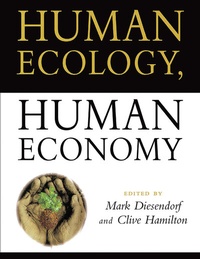
Human Ecology, Human Economy
Ideas for an ecologically sustainable future
1st Edition
Published on 31. March 2021
Book
Hardback
400 pages
978-0-367-71840-4 (ISBN)
Description
'A brilliant synthesis of ecology and economics that provides a sure guide to a sustainable future. It is a must for all environmentalists and economists.'
Charles Birch
'Written by an impressive list of experts across a number of disciplines, this readable text provides not only analysis but vigorous criticism-and answers.'
Robyn Williams
'This book is such a useful guide to responsible decision-making that it should be supplied in bulk to senior government officials and managers in the private sector.'
Ian Lowe
'This is a fine contribution to ecological economics coming from Australia, and of interest worldwide.'
Herman E Daly
Human well-being is wholly dependent upon the continued good health of the Earth s ecosystems. Human behaviour as it interacts with the biophysical environment is enormously complex, as governments (and individuals) who must make decisions about resource use are becoming increasingly aware. Human Ecology, Human Economy provides the basic concepts and tools for understanding how to analyse that interaction.
The book is designed to be used as a text for undergraduate and graduate students in environmental studies, human and social ecology, ecological economics, futures studies, and science and technology studies. It is also intended for interested members of the public and for policy-makers working on environmental issues, especially where these intersect with economic policy.
Human Ecology, Human Economy not only covers the basic concepts, but also moves to some of the frontiers of thinking in several case studies. It uses a problem and solution oriented approach which crosses disciplinary boundaries, drawing together elements from biology, economics, philosophy and political science.
Professor Mark Diesendorf is Director of the Institute for Sustainable Futures at the University of Technology, Sydney and Vice President of the Sustainable Energy Industries Council of Australia. Among the books he has edited are The Magic Bullet and Energy And People.
Dr Clive Hamilton is Executive Director of the Australia Institute, Canberra and teaches in the Public Policy Program at the Australian National University. His books include Capitalist Industrialisation In Korea, The Mystic Economist and The Economic Dynamics Of Australian Industry.
Charles Birch
'Written by an impressive list of experts across a number of disciplines, this readable text provides not only analysis but vigorous criticism-and answers.'
Robyn Williams
'This book is such a useful guide to responsible decision-making that it should be supplied in bulk to senior government officials and managers in the private sector.'
Ian Lowe
'This is a fine contribution to ecological economics coming from Australia, and of interest worldwide.'
Herman E Daly
Human well-being is wholly dependent upon the continued good health of the Earth s ecosystems. Human behaviour as it interacts with the biophysical environment is enormously complex, as governments (and individuals) who must make decisions about resource use are becoming increasingly aware. Human Ecology, Human Economy provides the basic concepts and tools for understanding how to analyse that interaction.
The book is designed to be used as a text for undergraduate and graduate students in environmental studies, human and social ecology, ecological economics, futures studies, and science and technology studies. It is also intended for interested members of the public and for policy-makers working on environmental issues, especially where these intersect with economic policy.
Human Ecology, Human Economy not only covers the basic concepts, but also moves to some of the frontiers of thinking in several case studies. It uses a problem and solution oriented approach which crosses disciplinary boundaries, drawing together elements from biology, economics, philosophy and political science.
Professor Mark Diesendorf is Director of the Institute for Sustainable Futures at the University of Technology, Sydney and Vice President of the Sustainable Energy Industries Council of Australia. Among the books he has edited are The Magic Bullet and Energy And People.
Dr Clive Hamilton is Executive Director of the Australia Institute, Canberra and teaches in the Public Policy Program at the Australian National University. His books include Capitalist Industrialisation In Korea, The Mystic Economist and The Economic Dynamics Of Australian Industry.
More details
Language
English
Place of publication
London
United Kingdom
Publishing group
Taylor & Francis Ltd
Target group
College/higher education
Dimensions
Height: 246 mm
Width: 189 mm
Weight
900 gr
ISBN-13
978-0-367-71840-4 (9780367718404)
Copyright in bibliographic data and cover images is held by Nielsen Book Services Limited or by the publishers or by their respective licensors: all rights reserved.
Schweitzer Classification
Other editions
Additional editions
Clive Hamilton
Human Ecology, Human Economy
E-Book
09/2020
1st Edition
Routledge
€44.99
Available for download
Clive Hamilton
Human Ecology, Human Economy
E-Book
09/2020
1st Edition
Routledge
€44.99
Available for download
Book
03/1997
1st Edition
Allen & Unwin
€62.15
Shipment within 3-4 weeks
Person
Mark Diesendorf is senior lecturer in the Human Ecology program at the Australian National University. Clive Hamilton is the Executive Director of the Australia Institute.
Content
List of tables
List of figures
List of boxes
Contributors
Acknowledgements
Introduction - Mark Diesendorf/Clive Hamilton
PART 1 - BASIC CONCEPTS
1 Humans in the biosphere - Stephen Boyden/Stephen Dovers
2 Foundations of ecological economics - Clive Hamilton
3 Principles of ecologically sustainable development - Mark Diesendorf
4 Economic growth and human well-being - Steve Dodds
5 Values and ethics - Janis Birkeland/Steve Dodds/Clive Hamilton
6 Trade and the environment - Henry Leveson-Gower
PART 2 - CASE STUDIES AND POLICY DIRECTIONS
7 Soils and agriculture - Jim Derrick/Paul Dann
8 Greenhouse response in the energy sector - Mark Diesendorf
9 Impacts of energy use - Bent Sorensen
10 Urban transport and urban form - Paul Mees
11 The ecologically sustainable development process in Australia - Mark Diesendorf/Clive Hamilton
12 Some path
List of figures
List of boxes
Contributors
Acknowledgements
Introduction - Mark Diesendorf/Clive Hamilton
PART 1 - BASIC CONCEPTS
1 Humans in the biosphere - Stephen Boyden/Stephen Dovers
2 Foundations of ecological economics - Clive Hamilton
3 Principles of ecologically sustainable development - Mark Diesendorf
4 Economic growth and human well-being - Steve Dodds
5 Values and ethics - Janis Birkeland/Steve Dodds/Clive Hamilton
6 Trade and the environment - Henry Leveson-Gower
PART 2 - CASE STUDIES AND POLICY DIRECTIONS
7 Soils and agriculture - Jim Derrick/Paul Dann
8 Greenhouse response in the energy sector - Mark Diesendorf
9 Impacts of energy use - Bent Sorensen
10 Urban transport and urban form - Paul Mees
11 The ecologically sustainable development process in Australia - Mark Diesendorf/Clive Hamilton
12 Some path