

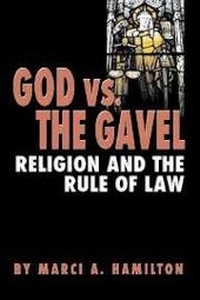
God vs. the Gavel
Religion and the Rule of Law
Published on 30. May 2005
Book
Hardback
428 pages
978-0-521-85304-0 (ISBN)
Description
God vs. the Gavel challenges the pervasive assumption that all religious conduct deserves constitutional protection. While religious conduct provides many benefits to society, it is not always benign. The thesis of the book is that anyone who harms another person should be governed by the laws that govern everyone else - and truth be told, religion is capable of great harm. This may not sound like a radical proposition, but it has been under assault since the 1960s. The majority of academics and many religious organizations would construct a fortress around religious conduct that would make it extremely difficult to prosecute child abuse by clergy, medical neglect of children by faith-healers, and other socially unacceptable behaviors. This book intends to change the course of the public debate over religion by bringing to the public's attention the tactics of religious entities to avoid the law and therefore harm others.
Reviews / Votes
'Professor Hamilton's book dazzles with lucid, original, and humane intelligence. The legal profession, academia and the general public will all enjoy learning from it. Let us hope the U.S. Supreme Court does not deviate again from its present conclusion on religious liberty as Hamilton explains it.' Rita Swan, Ph.D., President, Children's Healthcare Is a Legal Duty 'Marci Hamilton has heroically and truthfully confronted the widespread American myth that all things done in the name of religion are good and deserving of constitutional protections. She has accurately named the harm done in the name of religion and how this harm is protected and enabled by the courts and law enforcement by way of the inaccurate application of the First Amendment. God vs. The Gavel is essential reading for those who insist that religion be true to its fundamental mission and not about victimizing people for the sake of power, privilege or financial gain.' Thomas P. Doyle, O.P., J.C.D., C.A.D.C., Canon Lawyer, Advocate for those abused by Clergy 'For anyone interested in how the law should accommodate religious views in a modern pluralistic society this book is well worth reading ... The book is excellently researched ... worth the relatively modest investment of the cover price.' The Journal of the Law Society of ScotlandMore details
Language
English
Place of publication
Cambridge
United Kingdom
Target group
Professional and scholarly
Illustrations
Worked examples or Exercises
Dimensions
Height: 236 mm
Width: 159 mm
Thickness: 34 mm
Weight
700 gr
ISBN-13
978-0-521-85304-0 (9780521853040)
Copyright in bibliographic data and cover images is held by Nielsen Book Services Limited or by the publishers or by their respective licensors: all rights reserved.
Schweitzer Classification
Other editions
New editions
Book
08/2014
2nd Edition
Cambridge University Press
€110.10
Shipment within 15-20 days
Additional editions
E-Book
09/2005
1st Edition
Cambridge University Press
€24.99
Available for download
Persons
Marci A. Hamilton is a leading and internationally recognized constitutional expert specializing in church/state relations. She is a leading national expert on the Religious Freedom Restoration Act and is involved in cutting edge First Amendment litigation, involving clergy abuse (on behalf of victims) and land use (Religious Land Use and Institutionalized Persons Act).
Content
Part I. Why the Law Must Govern Religious Entities: 1. The problem; 2. Children; 3. Marriage; 4. Religious land use and residential neighborhoods; 5. Schools; 6. The prisons and the military; 7. Discrimination; Part II. The History and Doctrine behind the Rule that Subjects Religious Entities to Duly Enacted Laws: 8. Boerne v. Flores: the case that fully restored the rule of law for religious entities; 9. The decline of the special treatment of religious entities and the rise of the no-harm rule; 10. The path to the public good.