

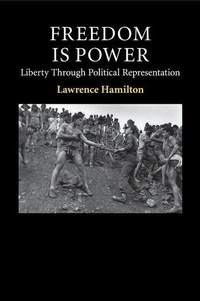
Freedom Is Power
Liberty through Political Representation
Published on 1. October 2015
Book
Paperback/Softback
244 pages
978-1-107-66034-2 (ISBN)
Description
Using the history of political thought and real-world political contexts, including South Africa and the recent global financial crisis, this book argues that power is integral to freedom. It demonstrates how freedom depends upon power, and contends that liberty for all citizens is best maintained if conceived as power through political representation. Against those who de-politicise freedom through a romantic conception of 'the people' and faith in supposedly independent judicial and political institutions, Lawrence Hamilton argues that real modern freedom can only be achieved through representative and participative mechanisms that limit domination and empower classes and groups who become disempowered in the conflicts that inevitably pervade politics. This is a sophisticated contribution to contemporary political theory that will be of interest to scholars and students of history, politics, philosophy, economics, sociology, development studies and Southern African studies.
Reviews / Votes
'Hamilton offers penetrating and novel insights into the complex character of human freedom in the contemporary world.' Anthony Butler, University of Cape Town 'Lawrence Hamilton's Freedom is Power is an impressive contribution to contemporary democratic theory. The book is both an analytically sophisticated, systematic effort in 'applied' political theory, and also a first-rate intervention into the history of political thought. It rigorously engages contemporary authors like Pettit, Foucault and others, but just as penetratingly delves into the work of Montesquieu, Rousseau, Constant, and especially, Machiavelli.' John P. McCormick, University of Chicago 'The book is intellectually stimulating, and its arguments are lucid and persuasively convincing. The author deploys historical analysis of relevant literature systematically to evolve a theory of political representation through empirical observation of the socio-economic and political realities of South Africa.' John Olushola Magbedelo, African Studies Quarterly 'In the context of 'complex modern polities and economies' - which is Hamilton's relentless and entirely appropriate focus - these 'institutional arrangements' ineluctably include arrangements for political representation. The underdiscussed importance of this, for Hamilton, derives from the fact that freedom involves the 'means and ability to determine who governs my political association or community - that is, the power to determine who represents me politically'.' Andrew Dobson, European Political ScienceMore details
Series
Language
English
Place of publication
Cambridge
United Kingdom
Target group
Professional and scholarly
Product notice
Paperback (trade)
Dimensions
Height: 229 mm
Width: 152 mm
Thickness: 13 mm
Weight
360 gr
ISBN-13
978-1-107-66034-2 (9781107660342)
Copyright in bibliographic data and cover images is held by Nielsen Book Services Limited or by the publishers or by their respective licensors: all rights reserved.
Schweitzer Classification
Other editions
Additional editions
Book
07/2014
Cambridge University Press
€89.50
Shipment within 15-20 days
Person
Lawrence Hamilton is Professor of Political Studies at the University of the Witwatersrand, and an Affiliated Lecturer in Political Theory in the Department of Politics and International Studies at the University of Cambridge. He is the author of The Political Philosophy of Needs (Cambridge, 2003).
Content
Introduction; 1. Freedom from politics; 2. Freedom through politics; 3. Power, domination and human needs; 4. Real modern freedom; 5. Freedom and representation; 6. Can and ought our political representatives control the economy?; Conclusion.