

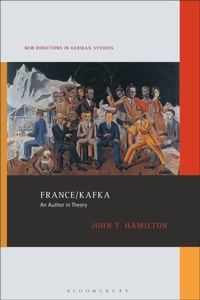
France/Kafka
An Author in Theory
Published on 9. February 2023
Book
Hardback
200 pages
979-8-7651-0036-3 (ISBN)
Description
While his memory languished under Nazi censorship, Franz Kafka covertly circulated through occupied France and soon emerged as a cultural icon, read by the most influential intellectuals of the time as a prophet of the rampant bureaucracy, totalitarian oppression, and absurdity that branded the twentieth century. In tracing the history of Kafka's reception in postwar France, John T. Hamilton explores how the work of a German-Jewish writer from Prague became a modern classic capable of addressing universal themes of the human condition.
Hamilton also considers how Kafka's unique literary corpus came to stimulate reflection in diverse movements, critical approaches, and philosophical schools, from surrealism and existentialism through psychoanalysis, phenomenology, and structuralism to Marxism, deconstruction, and feminism. The story of Kafka's afterlife in Paris thus furnishes a key chapter in the unfolding of French theory, which continues to guide how we read literature and understand its relationship to the world.
Hamilton also considers how Kafka's unique literary corpus came to stimulate reflection in diverse movements, critical approaches, and philosophical schools, from surrealism and existentialism through psychoanalysis, phenomenology, and structuralism to Marxism, deconstruction, and feminism. The story of Kafka's afterlife in Paris thus furnishes a key chapter in the unfolding of French theory, which continues to guide how we read literature and understand its relationship to the world.
Reviews / Votes
This valuable new addition to the vast terrain of Kafka scholarship examines in detail the early reception of the Prague author in France. Hamilton's [approach] is not a novel method-in the past couple of decades, such a richly contextualized approach has become the gold standard in the overlapping fields of reception history, translation studies, and comparative literature-but it is a compelling one. Coupled with Hamilton's lively, readable style, these merits will appeal to a wide range of students and academics interested in Kafka as well as in twentieth-century French theory. * Seminar: A Journal of Germanic Studies * A beautifully multilayered take on the interrelations between Kafka's works and the French theorists of the twentieth century who studied them. ... [France/Kafka] lends itself as a textbook for courses on literary theory and as an introduction to critical methodologies. And lastly, it is a pleasure to follow John Hamilton's expert guidance across time, languages, and cultures to learn about the chiastic, but intimate relation between Franz and France. * The Comparatist * What makes France/Kafka so compelling is precisely its refusal to resolve Kafka into coherence. Instead, Hamilton allows us to see how French readings of Kafka's textual strategies become tools for thinking in conditions of social crisis ... In France/Kafka readers will find an important study of reception, as well as a careful consideration of the meaning of literature itself. * Translation and Literature * Kafka lovers who are inclined to emulate their hero had better be en garde while opening this book: Kafka wrote, 'There is no having, only a being, only a state of being that craves the last breath.' John Hamilton's France/Kafka is literally breathtaking in its historical sense, theoretical finesse, and visual intelligence, observant of the finest telling detail. I risked danger and read France/Kafka in one go and with unstinting joy: there is no finer critic-close reader and philosopher-than John Hamilton, who, in Kafka and France, has found his predestined subject. * Stanley Corngold, Professor Emeritus of German and Comparative Literature, Princeton University, USA * France/Kafka: An Author in Theory shows John T. Hamilton at a new peak of his scholarly powers and demonstrates what Comparative Literature can accomplish today. An elegant dance in French, German, and English, Hamilton's book provides a comprehensive reconstruction of Kafka's aerolithic impact within the French intellectual context from surrealism and existentialism to feminism and deconstruction. Kafka, who considered himself a spiritual son of Gustave Flaubert, turns out to be the elusive godfather of French theory. While unfolding an erudite dossier of a century of cultural history, France/Kafka discreetly designs its own literary theory, revealing all reading as UEbersetzung. Franz Kafka is an author in continued translation: John T. Hamilton passes on the Imperial Message for the 21st century. * Eckart Goebel, Professor for Comparative Literature, University of Tuebingen, Germany * Indispensable for the study of Kafka's French reception. * French Studies * The book is resoundingly successful [...] There are many chestnuts and flourishes of erudition that deepen each subsequent writer in Hamilton's genealogy, none of which can easily be synthesized down to the framework of a review. Perhaps the most impressive part of the book is that, in the end, the slash itself, so vital to the logic of the book, falls away. It disappears not merely between France/Kafka,but inevitably between theory/practice as well. The book becomes an act of beholding, which Hamilton reminds us is the true root of theory * Modernism/Modernity * Hamilton is very good at reconstructing how various critical approaches were affected by the historical and political contexts of the occupation, resistance, and liberation in the wake of World War II. * German Studies Review *
More details
Series
Language
English
Place of publication
New York
United States
Publishing group
Bloomsbury Publishing Plc
Target group
College/higher education
Professional and scholarly
Product notice
Laminated cover
Dimensions
Height: 216 mm
Width: 140 mm
Thickness: 13 mm
Weight
376 gr
ISBN-13
979-8-7651-0036-3 (9798765100363)
Copyright in bibliographic data and cover images is held by Nielsen Book Services Limited or by the publishers or by their respective licensors: all rights reserved.
Schweitzer Classification
Other editions
Additional editions
E-Book
02/2023
1st Edition
Bloomsbury Academic USA
€22.99
Available for download
Person
John T. Hamilton is William R. Kenan Professor of German and Comparative Literature at Harvard University, USA. He is the author of seven books, including most recently Philology of the Flesh (University of Chicago Press, 2018) and Complacency: Classics and its Displacement in Higher Education. (University of Chicago Press, 2022).
Content
Abbreviations
I. Gradus ad Parnassum
The Writer and the Author in Theory ? Through a Glass, darkly ? From the Louvre to the Louvre ? An Improbable Apparition ? A Second Life
II. Metamorphoses
Naturalization Papers ? Amid Intimacy and Exoticism ? Universal Man ? Dreams, Rivers, Snow ? Translative Decisions ? Bifurcations
III. Trials
Paratexts ? The Adventurer ? The Saint ? A Certain Plume ? Extremism ? Non liquet
IV. Contingencies
Preoccupations ? Nothing but Nothing ? Seasickness on Land ? Phantom War ? Homo absurdus ? Impossible Hope ? Objective Style
V. Judgments
Upside Down, Right Side Up ? Disengagement ? Incendiaries ? The Child ? The Author in Theater
VI. Labyrinths
Signs of Change ? The New New ? Rhizomes ? Primal Scenes ? Derrida's Pharmacy
Bibliography
Index
I. Gradus ad Parnassum
The Writer and the Author in Theory ? Through a Glass, darkly ? From the Louvre to the Louvre ? An Improbable Apparition ? A Second Life
II. Metamorphoses
Naturalization Papers ? Amid Intimacy and Exoticism ? Universal Man ? Dreams, Rivers, Snow ? Translative Decisions ? Bifurcations
III. Trials
Paratexts ? The Adventurer ? The Saint ? A Certain Plume ? Extremism ? Non liquet
IV. Contingencies
Preoccupations ? Nothing but Nothing ? Seasickness on Land ? Phantom War ? Homo absurdus ? Impossible Hope ? Objective Style
V. Judgments
Upside Down, Right Side Up ? Disengagement ? Incendiaries ? The Child ? The Author in Theater
VI. Labyrinths
Signs of Change ? The New New ? Rhizomes ? Primal Scenes ? Derrida's Pharmacy
Bibliography
Index