

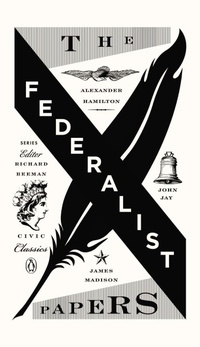
The Federalist Papers
Description
Written at a time when furious arguments were raging about the best way to govern America, The Federalist Papers had the immediate practical aim of persuading New Yorkers to accept the newly drafted Constitution in 1787. In this they were supremely successful, but their influence also transcended contemporary debate to win them a lasting place in discussions of American political theory. The Federalist Papers make a powerful case for power-sharing between State and Federal authorities and have only risen in legal influence over the last two centuries. Beeman's analysis helps clarify the goals, at once separate and in concert, of Madison, Hamilton, and Jay during their writing, and his selection of some of the most important papers show the array of issues-both philosophical and policy-specific-covered by this body of work.
"The best commentary on the principles of government which ever was written" - Thomas Jefferson
More details
Other editions
Additional editions
Persons
Alexander Hamilton was born in the British West Indian island of Nevis sometime between 1755 and 1757. During the American War of Independence, he was captain of a New York artillery company and soon thereafter was promoted to Lieutenant Colonel, serving as George Washington's secretary and aide-de-camp. He was a delegate to the Constitutional Convention of 1787 from New York, Following that Convention, he organized the writing of The Federalist essays, enlisting John Jay and James Madison in the effort. From 1789 to 1795 he served as America’s first secretary of the Treasury. A growing animosity between Hamilton and his longtime New York political rival Aaron Burr culminated in a duel between the two men in 1804. Hamilton was fatally shot and died the day after their encounter
John Jay was a consistent voice for reconciliation with Great Britain in the Continental Congress. While he did not sign the Declaration of Independence, he later worked to secure support for independence in his home state of New York. He was an influential member of the peace delegation that negotiated the treaty of peace with Great Britain ending the Revolutionary War. Recruited by Alexander Hamilton to write essays for The Federalist, his effort was hampered by illness. He later served as the first chief justice of the Supreme Court. He retired from the Supreme Court in 1795 and served as governor of New York for six years before retiring to a farm for the last twenty-seven years of his life.
Richard Beeman, the John Welsh Centennial Professor of History Emeritus at the University of Pennsylvania, has previously served as the Chair of the Department of History, Associate Dean in Penn's School of Arts and Sciences, and Dean of the College of Arts of Sciences. He serves as a trustee of the National Constitution Center and on the center's executive committee. Author of seven previous books, among them The Penguin Guide to the United States Constitution and Plain Honest Men: The Making of the American Constitution, Professor Beeman has received numerous grants and awards including fellowships from the National Endowment for the Humanities, the Rockefeller Foundation, the Institute for Advanced Study at Princeton, and the Huntington Library. His biography of Patrick Henry was a finalist for the National Book Award.