

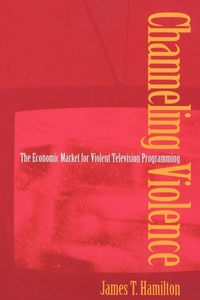
Channeling Violence
The Economic Market for Violent Television Programming
Will be published approx. on 17. September 2000
Book
Paperback/Softback
390 pages
978-0-691-07024-7 (ISBN)
Description
"If it bleeds, it leads." The phrase captures television news directors' famed preference for opening newscasts with the most violent stories they can find. And what is true for news is often true for entertainment programming, where violence is used as a product to attract both viewers and sponsors. In this book, James Hamilton presents the first major theoretical and empirical examination of the market for television violence. Hamilton approaches television violence in the same way that other economists approach the problem of pollution: that is, as an example of market failure. He argues that television violence, like pollution, generates negative externalities, defined as costs borne by others than those involved in the production activity. Broadcasters seeking to attract viewers may not fully bear the costs to society of their violent programming, if those costs include such factors as increased levels of aggression and crime in society. Hamilton goes on to say that the comparison to pollution remains relevant when considering how to deal with the problem.
Approaches devised to control violent programming, such as restricting it to certain times and rating programs according to the violence they contain, have parallels in zoning and education policies designed to protect the environment. Hamilton examines in detail the microstructure of incentives that operate at every level of television broadcasting, from programming and advertising to viewer behavior, so that remedies can be devised to reduce violent programming without restricting broadcasters' right to compete.
Approaches devised to control violent programming, such as restricting it to certain times and rating programs according to the violence they contain, have parallels in zoning and education policies designed to protect the environment. Hamilton examines in detail the microstructure of incentives that operate at every level of television broadcasting, from programming and advertising to viewer behavior, so that remedies can be devised to reduce violent programming without restricting broadcasters' right to compete.
Reviews / Votes
Winner of the 1999 Goldsmith Book Prize, Joan Shorenstein Center on the Press, Politics, and Public Policy at the JFK School of Government, Harvard University "This well-written and finely argued analysis begins by noting what we all-too-often take for granted: TV programming is in general profit driven, and, in particular, is strategically chosen to attract particular viewing audiences... Hamilton, effectively and adroitly, makes the analogy to air pollution in that in both cases producers do not consider the full societal and cultural costs of their activities."--Journalism and Mass Communication Quarterly "Drawing on economic theory and a wealth of empirical evidence, in addition to his previous complementary professional research on pollution control, Hamilton ... contributes significantly to the literature on television violence and the individual and societal stake in it... The book offers a wealth of data... Recommended."--ChoiceMore details
Language
English
Place of publication
New Jersey
United States
Target group
Professional and scholarly
College/higher education
Product notice
Paperback (trade)
Illustrations
16 line illus. 97 tables
Dimensions
Height: 229 mm
Width: 152 mm
Thickness: 24 mm
Weight
666 gr
ISBN-13
978-0-691-07024-7 (9780691070247)
Copyright in bibliographic data and cover images is held by Nielsen Book Services Limited or by the publishers or by their respective licensors: all rights reserved.
Schweitzer Classification
Other editions
Additional editions

E-Book
04/2022
1st Edition
Princeton University Press
€61.49
Available for download
Person
James T. Hamilton is Assistant Professor of Public Policy and Economics at Duke University.
Content
List of Figures ix List of Tables xi Preface xvii CHAPTER 1 Why Is Television Violence a Public Policy Issue? 3 CHAPTER 2 Adult Audiences: Who Watches Violent Programming'? 51 CHAPTER 3 Children as Viewers 76 CHAPTER 4 Programming Violence 129 CHAPTER 5 Advertising: Who Supports Violent Programming? 163 CHAPTER 6 Producer Incentives 211 CHAPTER 7 Local News as (Violent) Entertainment? 239 CHAPTER 8 Dealing with Television Violence: Politics and Policies 285 Notes 323 Bibliography 367 Index 385