

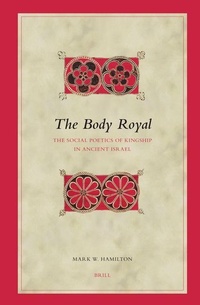
The Body Royal
The Social Poetics of Kingship in Ancient Israel
Published on 16. August 2005
Book
Hardback
320 pages
978-90-04-14541-2 (ISBN)
Description
The present volume seeks to identify the underlying code of meanings about the Israelite king operating in various ways in texts and other artifacts surviving from the culture. The focus is upon the (living) body of the king, its anatomical characteristics, its constitution through ritual, and the conventions concerning its proper self-display by the king. This study combines careful linguistic and historical-critical analysis of the texts considered (both biblical and ancient Near Eastern, the latter used comparatively where appropriate) with a critical use of contemporary approaches to the study of signs in language, objects, and movements (semiotics), in general, and the study of the body, in particular.
This book argues that the royal psalms contain a set of officially sanctioned notions about the royal body and its use. The king was thought to have an outsized, superhuman body owing to his being the son of the deity, a status he attained upon his coronation. Other texts, often from circles outside the royal court, significantly altered these notions.
The king's body was thus for ancient Israelites the locus of reflection on power, gender, religion, and even international relations. Through careful historical analysis, it is possible to reconstruct the terms of an Iron Age intellectual inquiry that still influences our contemporary world.
This book argues that the royal psalms contain a set of officially sanctioned notions about the royal body and its use. The king was thought to have an outsized, superhuman body owing to his being the son of the deity, a status he attained upon his coronation. Other texts, often from circles outside the royal court, significantly altered these notions.
The king's body was thus for ancient Israelites the locus of reflection on power, gender, religion, and even international relations. Through careful historical analysis, it is possible to reconstruct the terms of an Iron Age intellectual inquiry that still influences our contemporary world.
More details
Series
Language
English
Place of publication
Leiden
Netherlands
Target group
College/higher education
Product notice
sewn/stitched
Paper over boards
Dimensions
Height: 244 mm
Width: 166 mm
Thickness: 26 mm
Weight
730 gr
ISBN-13
978-90-04-14541-2 (9789004145412)
Copyright in bibliographic data and cover images is held by Nielsen Book Services Limited or by the publishers or by their respective licensors: all rights reserved.
Schweitzer Classification
Other editions
Additional editions

Software
11/2005
Brill
Unfortunately, price unknown
Available (delivery time upon request)
Person
Mark W. Hamilton received the Ph.D. in Near Eastern Languages and Civilizations from Harvard University. He is currently Assistant Professor of Hebrew Bible at Abilene Christian University, where he teaches Hebrew and biblical text. His current research focuses upon Israelite and ancient Near Eastern notions of sovereignty, human and divine, both in their historical contexts and in their implications for contemporary communities of faith.
Content
Acknowledgements
List of Abbreviations
Chapter one The Undiscovered Territory of the Body
Chapter two Creating the Body of the King in the Royal Psalm
Chapter three The Royal Body at Work
Chapter four Stories of the Coronation of the King
Chapter five While Horse and Hero Fell: Royal Death and Sickness
Chapter six The Body of the King in War and Peace
Chapter seven The Body of the Foreign King
Chapter eight Conclusions and Implications
General Index
List of Abbreviations
Chapter one The Undiscovered Territory of the Body
Chapter two Creating the Body of the King in the Royal Psalm
Chapter three The Royal Body at Work
Chapter four Stories of the Coronation of the King
Chapter five While Horse and Hero Fell: Royal Death and Sickness
Chapter six The Body of the King in War and Peace
Chapter seven The Body of the Foreign King
Chapter eight Conclusions and Implications
General Index