

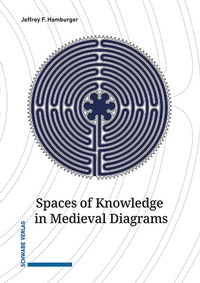
Spaces of Knowledge in Medieval Diagrams
1st Edition
Published on 24. November 2025
Book
Paperback/Softback
65 pages
978-3-7965-5411-7 (ISBN)
Description
The spatial structure of diagrams can be described in algebraic, geometric, cognitive or semiotic terms. Based on the ?Ur-diagram' of the Divided Line in Plato's ?Republic', diagrams can be understood as representations of the visible and the intelligible world. However, the knowledge thus conveyed is subject to the contingency of material and contextual, i.e., period-specific circumstances. How is the spatial organization of diagrams in medieval manuscripts structured under such conditions? The examples dealt with in this essay range from diagrammaric glosses to the late antique ?Corpus Dionysiacum' to visualizations of the powers of perception and cognition by the Renaissance scholar Charles Bovelles. Medieval spaces of knowledge encompassed not only the confines of libraries or the extended social networks within which books were written, exchanged, and read; they also took shape on the page, most persuasively in the form of diagrams.
More details
Other editions
Additional editions
Jeffrey F. Hamburger
Spaces of Knowledge in Medieval Diagrams
E-Book
12/2025
1st Edition
Schwabe Verlagsgruppe AG Schwabe Verlag
€29.00
Available for download
Person
Jeffrey F. Hamburger, born in 1957, is Kuno Francke Professor of German Art & Culture at Harvard University. He has published on medieval art, especially on illuminated manuscripts and on piety and mysticism. His research interests include text-image issues across various media, the history of diagrams and the art of female monasticism.