

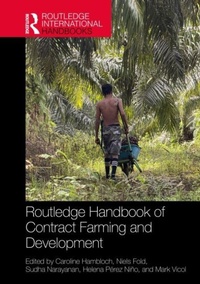
Routledge Handbook of Contract Farming and Development
1st Edition
Will be published approx. on 10. September 2026
Book
Hardback
496 pages
978-1-032-84528-9 (ISBN)
Description
The Routledge Handbook of Contract Farming and Development assesses the main conceptual, methodological, and theoretical debates surrounding contract farming, and its implications for rural development in the Global South.
Contract farming has rapidly expanded in the Global South in the wake of structural adjustment, providing an intermediate form of agricultural organization between open procurement and fully integrated plantation agriculture. However, it is also a focus of contestation, with some viewing it as a 'win-win' solution to the struggles of smallholders in the global south, and others viewing it through the lens of peasant exploitation. This book combines conceptual and methodological contributions with rich empirical case studies, encouraging a holistic understanding of contract farming by transcending disciplinary silos. Overall, the book equips readers with a rich understanding of key themes, policies, business models, actors, and social dynamics surrounding contract farming. It considers local and regional variations and contexts, and the broader implications of contract farming for agrarian change globally.
The book's comprehensive coverage of contract farming will be of interest to researchers across the fields of agricultural economics, development studies, rural sociology, and agrarian political economy. Its insights will also be instructive for policy makers and development practitioners looking for a comprehensive overview.
Contract farming has rapidly expanded in the Global South in the wake of structural adjustment, providing an intermediate form of agricultural organization between open procurement and fully integrated plantation agriculture. However, it is also a focus of contestation, with some viewing it as a 'win-win' solution to the struggles of smallholders in the global south, and others viewing it through the lens of peasant exploitation. This book combines conceptual and methodological contributions with rich empirical case studies, encouraging a holistic understanding of contract farming by transcending disciplinary silos. Overall, the book equips readers with a rich understanding of key themes, policies, business models, actors, and social dynamics surrounding contract farming. It considers local and regional variations and contexts, and the broader implications of contract farming for agrarian change globally.
The book's comprehensive coverage of contract farming will be of interest to researchers across the fields of agricultural economics, development studies, rural sociology, and agrarian political economy. Its insights will also be instructive for policy makers and development practitioners looking for a comprehensive overview.
More details
Series
Language
English
Place of publication
London
United Kingdom
Publishing group
Taylor & Francis Ltd
Target group
College/higher education
Professional and scholarly
Academic, Postgraduate, and Professional Reference
Illustrations
9 s/w Abbildungen, 2 s/w Photographien bzw. Rasterbilder, 7 s/w Zeichnungen, 18 s/w Tabellen
18 Tables, black and white; 7 Line drawings, black and white; 2 Halftones, black and white; 9 Illustrations, black and white
Dimensions
Height: 246 mm
Width: 174 mm
Weight
453 gr
ISBN-13
978-1-032-84528-9 (9781032845289)
Copyright in bibliographic data and cover images is held by Nielsen Book Services Limited or by the publishers or by their respective licensors: all rights reserved.
Schweitzer Classification
Persons
Caroline Hambloch leads the DFG Junior Research Group, "Local Labor Struggles in Global Value Chains", at the University of Bonn. Her research examines the political economy of contract farming, global value chains, and labor agency. She holds a PhD in Economics from the School of Oriental and African Studies (SOAS).
Niels Fold is Professor at the Department of Geosciences and Natural Resource Management, University of Copenhagen. His research addresses the relationship between economic-geographic globalization processes and local responses in the Global South, primarily examined through the analytical lens of global value chains (GVCs) and livelihoods.
Sudha Narayanan is a Senior Research Fellow, International Food Policy Research Institute (IFPRI), New Delhi. She holds a PhD in agricultural economics from Cornell University and dual master's degrees in economics from the Delhi School of Economics, India. Her recent work includes a book titled Contract Farming in Developing Countries: The Promise and its Perils, published by Palgrave Macmillan.
Helena Perez Nino is Assistant Professor at ISS Erasmus University Rotterdam and conducts research on the political economy of development with special emphasis on the social organisation of production in agriculture and the social impact of globalised agricultural markets. Her current research examines agricultural intensification and underwhelming trajectories of productive upgrade.
Mark Vicol is Assistant Professor of Agrarian Sociology in the Rural Sociology Group and co-coordinator of the Critical Agrarian Studies research cluster at Wageningen University.
Niels Fold is Professor at the Department of Geosciences and Natural Resource Management, University of Copenhagen. His research addresses the relationship between economic-geographic globalization processes and local responses in the Global South, primarily examined through the analytical lens of global value chains (GVCs) and livelihoods.
Sudha Narayanan is a Senior Research Fellow, International Food Policy Research Institute (IFPRI), New Delhi. She holds a PhD in agricultural economics from Cornell University and dual master's degrees in economics from the Delhi School of Economics, India. Her recent work includes a book titled Contract Farming in Developing Countries: The Promise and its Perils, published by Palgrave Macmillan.
Helena Perez Nino is Assistant Professor at ISS Erasmus University Rotterdam and conducts research on the political economy of development with special emphasis on the social organisation of production in agriculture and the social impact of globalised agricultural markets. Her current research examines agricultural intensification and underwhelming trajectories of productive upgrade.
Mark Vicol is Assistant Professor of Agrarian Sociology in the Rural Sociology Group and co-coordinator of the Critical Agrarian Studies research cluster at Wageningen University.
Content
1. Introduction: Contract Farming and Development Part I: Concepts and Methods 2. Contract farming and the agrarian question: some reflections on contracts and capital 3. New institutional economics perspectives on contract farming 4. Contract farming and the selection problem: an econometric dilemma 5. Meta-analysis of contract farming: towards realist synthesis 6. Contract farming in global value chains and global production networks 7. Political ecology perspectives on contract farming: environmental crises 8. Contract farming and development discourses: a historical overview Part II: Actors 9. Workers and labor regimes in contract farming 10. Cooperatives and contract farming arrangements 11. Contracting farming schemes and the diversity of scale and factions of capital 12. Contract farming, intermediaries and oral enforcement of contracts 13. Diversity of traders: middle-people, petty traders and big traders 14. Supermarkets and contract farming 15. The state and contract farming in Africa Part III: Dynamics 16. Contract farming and terms of the contract: a review of best practices 17. Contracts in the real world 18. Inclusion of smallholders in contract farming 19. Inclusive business models and contract farming 20. Agricultural intensification and informal contract farming 21. Why are so few farmers contracted by retail chains in the Global South? 22. Regional economic development and contract farming 23. Land reform and contract farming 24. Land grabbing and contract farming 25. Land, land rentals and contract farming 26. Plant pathogens, power and contract farming 27. Credit and indebtedness in contract farming 28. Exploitation in contract farming 29. Resistance and contract farming 30. Contract farming and social movements Part IV: Regional Patterns 31. Contract farming in Sub-Saharan Africa 32. Contract farming in South Asia 33. Contract farming in China 34. Contract farming in Latin America 35. Contract farming in Central Asia 36. Contract farming in the Mekong region of Southeast Asia