

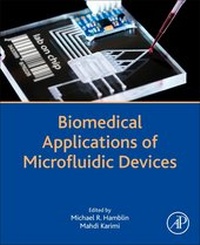
Biomedical Applications of Microfluidic Devices
Published on 18. November 2020
Book
Paperback/Softback
350 pages
978-0-12-818791-3 (ISBN)
Description
Biomedical Applications of Microfluidic Devices introduces the subject of microfluidics and covers the basic principles of design and synthesis of actual microchannels. The book then explores how the devices are coupled to signal read-outs and calibrated, including applications of microfluidics in areas such as tissue engineering, organ-on-a-chip devices, pathogen identification, and drug/gene delivery. This book covers high-impact fields (microarrays, organ-on-a-chip, pathogen detection, cancer research, drug delivery systems, gene delivery, and tissue engineering) and shows how microfluidics is playing a key role in these areas, which are big drivers in biomedical engineering research.
This book addresses the fundamental concepts and fabrication methods of microfluidic systems for those who want to start working in the area or who want to learn about the latest advances being made. The subjects covered are also an asset to companies working in this field that need to understand the current state-of-the-art. The book is ideal for courses on microfluidics, biosensors, drug targeting, and BioMEMs, and as a reference for PhD students. The book covers the emerging and most promising areas of biomedical applications of microfluidic devices in a single place and offers a vision of the future.
This book addresses the fundamental concepts and fabrication methods of microfluidic systems for those who want to start working in the area or who want to learn about the latest advances being made. The subjects covered are also an asset to companies working in this field that need to understand the current state-of-the-art. The book is ideal for courses on microfluidics, biosensors, drug targeting, and BioMEMs, and as a reference for PhD students. The book covers the emerging and most promising areas of biomedical applications of microfluidic devices in a single place and offers a vision of the future.
More details
Language
English
Place of publication
San Diego
United States
Publishing group
Elsevier Science Publishing Co Inc
Target group
College/higher education
Biomedical Engineers, Mechanical Engineers, Chemical Engineers, Electrical Engineers, nanotechnologists, post-graduates in biomedical engineering and nanotechnology. Biomedical researchers, chemists, microbiologists, pharmaceutical scientists
Illustrations
Approx. 150 illustrations (150 in full color)
Dimensions
Height: 235 mm
Width: 191 mm
Weight
680 gr
ISBN-13
978-0-12-818791-3 (9780128187913)
Copyright in bibliographic data and cover images is held by Nielsen Book Services Limited or by the publishers or by their respective licensors: all rights reserved.
Schweitzer Classification
Other editions
Additional editions
Michael R. Hamblin | Mahdi Karimi
Biomedical Applications of Microfluidic Devices
E-Book
11/2020
Academic Press
€160.00
Available for download
Persons
Michael R Hamblin Ph.D. is a Principal Investigator at the Wellman Center for Photomedicine at Massachusetts General Hospital, an Associate Professor of Dermatology at Harvard Medical School and is a member of the affiliated faculty of the Harvard-MIT Division of Health Science and Technology. He was trained as a synthetic organic chemist and received his PhD from Trent University in England. His research interests lie in the areas of photodynamic therapy (PDT) for infections, cancer, and heart disease and in low-level light therapy (LLLT) for wound healing, arthritis, traumatic brain injury and hair-regrowth. He directs a laboratory of around a sixteen post-doctoral fellows, visiting scientists and graduate students. His research program is supported by NIH, CDMRP, USAFOSR and CIMIT among other funding agencies. He has published 252 peer-reviewed articles, over 150 conference proceedings, book chapters and International abstracts and holds 8 patents. He is Associate Editor for 7 journals, on the editorial board of a further 12 journals and serves on NIH Study Sections. For the past 9 years Dr Hamblin has chaired an annual conference at SPIE Photonics West entitled "Mechanisms for low level light therapy" and he has edited the 9 proceedings volumes together with four other major textbooks on PDT and photomedicine. He has several other book projects in progress at various stages of completion. In 2011 Dr Hamblin was honored by election as a Fellow of SPIE. He received his BSc degree in Medical Laboratory Science from Iran University of Medical Science (IUMS), in 2005. In 2008, he received the MSc degree in Medical Biotechnology from Tabriz University of Medical Science and joined the Tarbiat Modares University as a PhD student in the nanobiotechnology field and received his PhD in 2013. During his research, in 2012, he became affiliated with the laboratory of Professor Michael Hamblin in the Wellman Center for Photomedicine at Massachusetts General Hospital and Harvard Medical School as a visiting researcher, where he contributed to the design and construction of new smart nanoparticles for drug/gene delivery. His current research interests include the design of smart nanoparticles in drug/gene delivery and microfluidic systems. He has established a scientific collaboration between his lab and Professor Michael Hamblin's lab to design new classes of smart nanovehicles in drug/gene delivery systems.
Content
1. Microfluidic devices: Concepts
2. Microfludic devices: Synthesis approaches
3. Design of microchannels in microfluidic devices
4. Microarray technologies
5. Organ-on-a-chip devices
6. Microfluidic devices for pathogen detection
7. Microfluidic devices for detection of cancer cells
8. Microfluidic devices for drug delivery systems
9. Microfluidic devices for gene delivery systems
10. Microfluidic devices for tissue engineering
11. Microfludics in organic chemistry
12. Microfludics in inorganic chemistry
13. Paper based microfluidic devices
14. Smart phone based microfluidic devices
15. Microfluidics: Future perspectives
2. Microfludic devices: Synthesis approaches
3. Design of microchannels in microfluidic devices
4. Microarray technologies
5. Organ-on-a-chip devices
6. Microfluidic devices for pathogen detection
7. Microfluidic devices for detection of cancer cells
8. Microfluidic devices for drug delivery systems
9. Microfluidic devices for gene delivery systems
10. Microfluidic devices for tissue engineering
11. Microfludics in organic chemistry
12. Microfludics in inorganic chemistry
13. Paper based microfluidic devices
14. Smart phone based microfluidic devices
15. Microfluidics: Future perspectives