

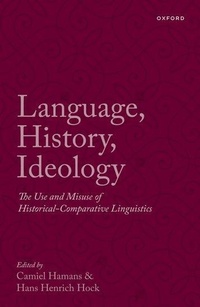
Language, History, Ideology
The Use and Misuse of Historical-Comparative Linguistics
Published on 20. May 2024
Book
Hardback
384 pages
978-0-19-882789-4 (ISBN)
Description
This volume presents twelve in-depth case studies that critically examine the ways in which historical linguistics and language change interact with ideology. These varying interactions have been present since the birth of historical-comparative linguistics as a field of study. Work in historical linguistics may be appropriated or rejected for ideological reasons, most notably in the debates surrounding the Indo-European homeland; it can also by influenced by ideological biases, as in the 'alternative' histories that have been proposed for Moldovan and Maltese. The development of linguistically-defined nation states may itself fuel linguistic change, for instance through the suppression of minority languages or the division of existing languages to mirror political divisions, as occurred in the Balkans; or it may lead to the formulation of pseudo-histories designed to give a nation a more prestigious past. The book will be of interest not only to historical linguists but also to anthropologists, historians, and all those interested in language policy.
More details
Language
English
Place of publication
Oxford
United Kingdom
Product notice
sewn/stitched
Cloth over boards
Dimensions
Height: 231 mm
Width: 160 mm
Thickness: 43 mm
Weight
748 gr
ISBN-13
978-0-19-882789-4 (9780198827894)
Copyright in bibliographic data and cover images is held by Nielsen Book Services Limited or by the publishers or by their respective licensors: all rights reserved.
Schweitzer Classification
Other editions
Additional editions
Camiel Hamans | Hans Henrich Hock
Language, History, Ideology
The Use and Misuse of Historical-Comparative Linguistics
E-Book
05/2024
1st Edition
OUP eBook
€119.99
Available for download
Persons
Camiel Hamans is Associate Secretary-General of the Comite International Permanent des Linguistes (CIPL), having previously held positions at the universities of Amsterdam, Leiden, and Poznan, where he taught Dutch modern and historical linguistics. He is a Fellow of the Maatschappij der Nederlandse Letterkunde (Leiden) and of the Wiardi Beckman Stichting, the thinktank of the Dutch Labour Party.
Hans Henrich Hock is Professor Emeritus of Linguistics at the University of Illinois. His research interests are in Indo-European and general comparative-historical linguistics with a focus on Sanskrit/Indo-Aryan and language contact. He is a Fellow of the Linguistic Society of America and an Honorary Life Member of the Societas Linguistica Europaea.
Hans Henrich Hock is Professor Emeritus of Linguistics at the University of Illinois. His research interests are in Indo-European and general comparative-historical linguistics with a focus on Sanskrit/Indo-Aryan and language contact. He is a Fellow of the Linguistic Society of America and an Honorary Life Member of the Societas Linguistica Europaea.
Content
1: Camiel Hamans and Hans Henrich Hock: Introduction
2: Johanna Laakso: Misunderstanding historical linguistics: Three Uralic examples
3: Kristjan Arnason: Ideologies and linguistic development in North Germanic
4: Hans Henrich Hock: Ideology and recent attacks on historical-comparative methodology: Historical linguistics under siege?
5: Hans Henrich Hock: Indo-European linguistic palaeontology and ideology: Nice wheels!
6: Brian D. Joseph: Historical linguistics and the Macedonia name issue: What's in a name?
7: Anders Ahlqvist: Celtic and English language contact and scholarly attitudes
8: Johanna Laakso: Borrowing and historical-linguistic ideology
9: Camiel Hamans: The origin of Afrikaans: Purism or language contact?
10: John Charles Smith: Moldovan and Maltese and the poverty of historicism in Romance linguistics
11: Ranko Bugarski: The breakup of the national language of the former Yugoslavia: Speeding up language change
12: Camiel Hamans: The European Charter for Regional and Minority Languages: Turning the tide against linguistic nationalism
13: Ferdinand von Mengden and Britta Schneider: Methodological nationalism and (anti-)historicism in the history of linguistics: Linguistic essentialism
2: Johanna Laakso: Misunderstanding historical linguistics: Three Uralic examples
3: Kristjan Arnason: Ideologies and linguistic development in North Germanic
4: Hans Henrich Hock: Ideology and recent attacks on historical-comparative methodology: Historical linguistics under siege?
5: Hans Henrich Hock: Indo-European linguistic palaeontology and ideology: Nice wheels!
6: Brian D. Joseph: Historical linguistics and the Macedonia name issue: What's in a name?
7: Anders Ahlqvist: Celtic and English language contact and scholarly attitudes
8: Johanna Laakso: Borrowing and historical-linguistic ideology
9: Camiel Hamans: The origin of Afrikaans: Purism or language contact?
10: John Charles Smith: Moldovan and Maltese and the poverty of historicism in Romance linguistics
11: Ranko Bugarski: The breakup of the national language of the former Yugoslavia: Speeding up language change
12: Camiel Hamans: The European Charter for Regional and Minority Languages: Turning the tide against linguistic nationalism
13: Ferdinand von Mengden and Britta Schneider: Methodological nationalism and (anti-)historicism in the history of linguistics: Linguistic essentialism