

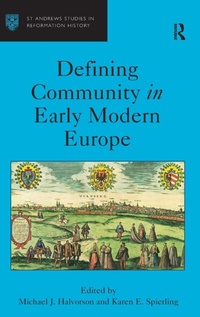
Defining Community in Early Modern Europe
1st Edition
Published on 28. November 2008
Book
Hardback
384 pages
978-0-7546-6153-5 (ISBN)
Description
Numerous historical studies use the term "community'" to express or comment on social relationships within geographic, religious, political, social, or literary settings, yet this volume is the first systematic attempt to collect together important examples of this varied work in order to draw comparisons and conclusions about the definition of community across early modern Europe. Offering a variety of historical and theoretical approaches, the sixteen original essays in this collection survey major regions of Western Europe, including France, Geneva, the German Lands, Italy and the Spanish Empire, the Netherlands, England, and Scotland. Complementing the regional diversity is a broad spectrum of religious confessions: Roman Catholic communities in France, Italy, and Germany; Reformed churches in France, Geneva, and Scotland; Lutheran communities in Germany; Mennonites in Germany and the Netherlands; English Anglicans; Jews in Germany, Italy, and the Netherlands; and Muslim converts returning to Christian England. This volume illuminates the variety of ways in which communities were defined and operated across early modern Europe: as imposed by community leaders or negotiated across society; as defined by belief, behavior, and memory; as marked by rigid boundaries and conflict or by flexibility and change; as shaped by art, ritual, charity, or devotional practices; and as characterized by the contending or overlapping boundaries of family, religion, and politics. Taken together, these chapters demonstrate the complex and changeable nature of community in an era more often characterized as a time of stark certainties and inflexibility. As a result, the volume contributes a vital resource to the ongoing efforts of scholars to understand the creation and perpetuation of communities and the significance of community definition for early modern Europeans.
Reviews / Votes
'Defining Community offers rich observation and analysis of community life, which will appeal to a broad spectrum of scholars.' Journal of Ecclesiastical History 'As a preliminary effort to assess the state of the field of communal studies, this volume of essays is a most welcome and appropriate addition to the literature.' Religious Studies Review 'This excellent collection of papers demonstrates how current cultural historians can do justice to a key idea and human experience by capturing its diversity, complexity, and subtlety. Here community is not sublime but historicized, and thus the volume deserves wide attention among scholars of culture and social interaction.' Sixteenth Century Journal 'The editors of this excellent volume are firstly to be commended for their informative introduction. They provide a very useful overview of recent research into community formation and definition in early modern Europe, stressing both the factors that allowed social, religious and political groups to assert their identity and also the many issues that made sustaining community cohesion an endlessly challenging task.' Reformation and Renaissance ReviewMore details
Series
Language
English
Place of publication
London
United Kingdom
Publishing group
Taylor & Francis Ltd
Target group
College/higher education
Professional and scholarly
Dimensions
Height: 240 mm
Width: 161 mm
Thickness: 25 mm
Weight
743 gr
ISBN-13
978-0-7546-6153-5 (9780754661535)
Copyright in bibliographic data and cover images is held by Nielsen Book Services Limited or by the publishers or by their respective licensors: all rights reserved.
Schweitzer Classification
Other editions
Additional editions
Michael J. Halvorson | Karen E. Spierling
Defining Community in Early Modern Europe
E-Book
12/2016
Routledge
€60.49
Available for download
Michael J. Halvorson | Karen E. Spierling
Defining Community in Early Modern Europe
E-Book
12/2016
Routledge
€60.49
Available for download
Persons
Michael J. Halvorson is Assistant Professor of History at Pacific Lutheran University, USA and Karen E. Spierling is Visiting Associate Professor of History at Ohio State University, USA.
Content
Contents: Introduction: definitions of community in early modern Europe, Karen E. Spierling and Michael J. Halvorson. The French-Speaking Lands: Communities of worship and the reformed churches of France, Raymond A. Mentzer; Between the living and the dead: preserving confessional identity and community in early modern France, S. Amanda Eurich; A community of active religious women, Susan E. Dinan; The complexity of community in Reformation Geneva: the case of the Lullin family, Karen E. Spierling. The German-Speaking Lands: Child circulation within the early modern urban community: rejection and support of unwanted children in Nuremberg, Joel F. Harrington; Late 16th-century Lutherans: a community of memory?, Susan R. Boettcher; Jewish communities in Central Europe in the 16th century, Dean Phillip Bell; Demonstrationes catholicae: defining communities through Counter-Reformation rituals, John M. Frymire; Lutherans baptizing Jews: examination reports and confessional polemics from Reformation Germany, Michael J. Halvorson. Northern Europe: England, Scotland, and The Netherlands: Beating the bounds of the parish: order, memory and identity in the English local community, c1500-1700, Steve Hindle; Breaching 'community' in Britain: captives, renegades, and the redeemed, Claire S. Schen; Scotland's 'city on a hill': the godly and the political community in early Reformation Scotland, Kristen Post Walton; Competing visions of the Mennonite gemeinde: examples from early modern Krefeld in their Dutch context, Michael Driedger. Italy: 'I can't imagine it won't bear fruit': Jesuits, politics, and heretics in Siena, Montepulciano and Lucca, Kathleen M. Comerford; Contesting Vesuvius and claiming Naples: disaster in print and pen, 1631-1649, Sean Cocco; Select bibliography; Index.