

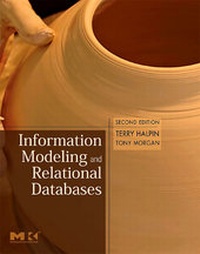
Information Modeling and Relational Databases
From Conceptual Analysis to Logical Design
2nd Edition
Published on 10. April 2008
Book
Hardback
976 pages
978-0-12-373568-3 (ISBN)
Description
Information Modeling and Relational Databases, Second Edition, provides an introduction to ORM (Object-Role Modeling)and much more. In fact, it is the only book to go beyond introductory coverage and provide all of the in-depth instruction you need to transform knowledge from domain experts into a sound database design. This book is intended for anyone with a stake in the accuracy and efficacy of databases: systems analysts, information modelers, database designers and administrators, and programmers.
Terry Halpin, a pioneer in the development of ORM, blends conceptual information with practical instruction that will let you begin using ORM effectively as soon as possible. Supported by examples, exercises, and useful background information, his step-by-step approach teaches you to develop a natural-language-based ORM model, and then, where needed, abstract ER and UML models from it. This book will quickly make you proficient in the modeling technique that is proving vital to the development of accurate and efficient databases that best meet real business objectives.
Terry Halpin, a pioneer in the development of ORM, blends conceptual information with practical instruction that will let you begin using ORM effectively as soon as possible. Supported by examples, exercises, and useful background information, his step-by-step approach teaches you to develop a natural-language-based ORM model, and then, where needed, abstract ER and UML models from it. This book will quickly make you proficient in the modeling technique that is proving vital to the development of accurate and efficient databases that best meet real business objectives.
Reviews / Votes
"This book is an excellent introduction to both information modeling in ORM and relational databases. The book is very clearly written in a step-by-step manner, and contains an abundance of well-chosen examples illuminating practice and theory in information modeling. I strongly recommend this book to anyone interested in conceptual modeling and databases." --Dr. Herman Balsters, Director of the Faculty of Industrial Engineering, University of Groningen, The NetherlandsMore details
Edition
2nd edition
Language
English
Place of publication
San Francisco
United States
Publishing group
Elsevier Science & Technology
Target group
Professional and scholarly
The audience is the same as for the first edition: data modelers, database designers, information architects, and practitioners/managers in data management.
Edition type
New edition
Illustrations
Approx. 690 illustrations
Dimensions
Height: 235 mm
Width: 191 mm
Weight
1790 gr
ISBN-13
978-0-12-373568-3 (9780123735683)
Copyright in bibliographic data and cover images is held by Nielsen Book Services Limited or by the publishers or by their respective licensors: all rights reserved.
Schweitzer Classification
Other editions
New editions
Terry Halpin | Tony Morgan
Information Modeling and Relational Databases
Book
07/2024
3rd Edition
Morgan Kaufmann
€124.50
Shipment within 15-20 days
Persons
Dr. Terry Halpin, is a Principal Scientist at LogicBlox, headquartered in Atlanta, USA, and a Professor at INTI International University, Malaysia. After many years in academia, he worked on data modeling technology at Asymetrix Corporation, InfoModelers Inc., Visio Corporation, and Microsoft Corporation, before returning to academia as Distinguished Professor at Neumont University (Utah, USA), and then once again returning to industry at LogicBlox and also taking a professorship at INTI. His research focuses on conceptual modeling and conceptual query technology. Dr. Halpin is the recipient of the DAMA International Academic Achievement Award and the IFIP Outstanding Service Award. He is a member of IFIP WG 8.1 (Design and Evaluation of Information Systems), is an editor or reviewer for several academic journals and international program committees, has co-chaired several international workshops on modeling, and has presented at dozens of international conferences in both industry and academia. For many years, his research has focused on conceptual modeling and conceptual query technology for information systems, using a business rules approach. His doctoral thesis formalized Object-Role Modeling (ORM/NIAM), and his publications include over 160 technical papers, and six books, including Information Modeling and Relational Databases, Second Edition, Elsevier/Morgan Kaufmann. Dr. Tony Morgan is a British computer scientist, data modeling consultant, and Professor in Computer Science at INTI International University, Malaysia. Dr. Morgan obtained his BA in Earth Sciences from The Open University, his BSc in Computer Systems Engineering from Coventry University, where in 1984 he also obtained his MSc in Control Engineering. In 1988 he obtained his PhD in Computer Science from University of Cambridge with a thesis on automated decision-making using qualitative reasoning. Dr. Morgan has done extensive work in industry with companies such as Unisys, EDS, and other corporations across transport, aerospace, government, and financial services, including the UK's National Computing Centre in Manchester. Dr. Morgan has published several articles on AI and simulation. In 2003 he was appointed Professor of Computer Science and Vice President of Enterprise Informatics at Neumont University, Utah, USA. His research interests focus on business rules and business processes and the rapid development of high-quality information systems. Along with Dr. Halpin, he is the co-author of Information Modeling and Relational Databases, Second Edition, Elsevier/Morgan Kaufmann.
Content
1 Introduction
2 Information Levels and Frameworks
3 Conceptual Modeling: First Steps
4 Uniqueness Constraints
5 Mandatory Roles
6 Value, Set-Comparison and Subtype Constraints
7 Other Constraints and Final Checks
8 Entity Relationship Modeling
9 Data Modeling in UML
10 Advanced Modeling Issues
11 Relational Mapping
12 Data Manipulation with Relational Languages
13 Using Other Database Objects
14 Schema Transformations
15 Process and State Modeling
16 Other Modeling Aspects and Trends
2 Information Levels and Frameworks
3 Conceptual Modeling: First Steps
4 Uniqueness Constraints
5 Mandatory Roles
6 Value, Set-Comparison and Subtype Constraints
7 Other Constraints and Final Checks
8 Entity Relationship Modeling
9 Data Modeling in UML
10 Advanced Modeling Issues
11 Relational Mapping
12 Data Manipulation with Relational Languages
13 Using Other Database Objects
14 Schema Transformations
15 Process and State Modeling
16 Other Modeling Aspects and Trends