

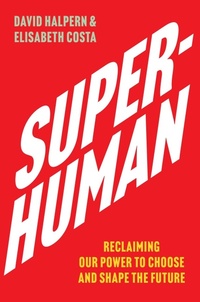
Superhuman
Reclaiming Our Power to Choose and Shape the Future
Will be published approx. on 3. December 2026
Book
Hardback
320 pages
978-0-06-347848-0 (ISBN)
Description
The world's leading researchers on human behavior and decision-making equip us with the knowledge, tools, and techniques to become better decision makers-and ultimately improve the world around us-in this powerful guide that builds on the insights of the influential bestseller Nudge.
When it appeared in 2008, the surprise bestseller Nudge showed how a nudge-a prompt, encouragement, or signal that suggests a behavior-could help us make better decisions. Nudge became "a beacon for using behavioral science to guide decisions and policies," according to David Halpern. But over the past eighteen years, that "beacon" has evolved. Where nudges led us to make better decisions, boosts now help us become better decision-makers.
Nudges accept our natural tendencies or biases and work to shift our behavior in the moment. Boosts, by contrast, enhance our ability to reflect, decide, or achieve something that matters. An app that prompts a moment of thought before we open a social media feed to doomscroll is a boost. So is teaching kids to stop and think-rather than fight-in moments of disagreement.
Boosts are designed to make us better decision makers in every part of our lives. Leading behavioural researchers David Halpern and Elisabeth Costa have run more than 1,000 experiments and interventions across more than seventy countries that show how behavioral science can improve our capacity to make better decisions, bolster our economies, improve our relationships, and harness tech to do good rather than harm. Boost pairs their rigorous scientific findings with a compelling range of stories, to reveal:
How boosts can help us be better bullshit detectors
How a boost led to a reduction in urban violence
How asking about pizza and sports boosted a billion-dollar tutoring program's success
How a daring experiment at the world's biggest social media company boosted its users into shapers of the platform and its rules
Boost puts humans back in the driver's seat, empowering them to regain agency so they can shape-rather than be manipulated by-the forces around them. Boost equips us with knowledge, tools and techniques to boost our own decision-making, and shows how we can shape the world around us to make it easier for everyone to choose well. Against the backdrop of rapidly evolving AI, Boost ultimately asks us to make the biggest choice of all: to decide what kind of humans we want to be.
When it appeared in 2008, the surprise bestseller Nudge showed how a nudge-a prompt, encouragement, or signal that suggests a behavior-could help us make better decisions. Nudge became "a beacon for using behavioral science to guide decisions and policies," according to David Halpern. But over the past eighteen years, that "beacon" has evolved. Where nudges led us to make better decisions, boosts now help us become better decision-makers.
Nudges accept our natural tendencies or biases and work to shift our behavior in the moment. Boosts, by contrast, enhance our ability to reflect, decide, or achieve something that matters. An app that prompts a moment of thought before we open a social media feed to doomscroll is a boost. So is teaching kids to stop and think-rather than fight-in moments of disagreement.
Boosts are designed to make us better decision makers in every part of our lives. Leading behavioural researchers David Halpern and Elisabeth Costa have run more than 1,000 experiments and interventions across more than seventy countries that show how behavioral science can improve our capacity to make better decisions, bolster our economies, improve our relationships, and harness tech to do good rather than harm. Boost pairs their rigorous scientific findings with a compelling range of stories, to reveal:
How boosts can help us be better bullshit detectors
How a boost led to a reduction in urban violence
How asking about pizza and sports boosted a billion-dollar tutoring program's success
How a daring experiment at the world's biggest social media company boosted its users into shapers of the platform and its rules
Boost puts humans back in the driver's seat, empowering them to regain agency so they can shape-rather than be manipulated by-the forces around them. Boost equips us with knowledge, tools and techniques to boost our own decision-making, and shows how we can shape the world around us to make it easier for everyone to choose well. Against the backdrop of rapidly evolving AI, Boost ultimately asks us to make the biggest choice of all: to decide what kind of humans we want to be.
More details
Language
English
Place of publication
New York
United States
Publishing group
HarperCollins Publishers Inc
Dimensions
Height: 229 mm
Width: 152 mm
Thickness: 25 mm
Weight
646 gr
ISBN-13
978-0-06-347848-0 (9780063478480)
Copyright in bibliographic data and cover images is held by Nielsen Book Services Limited or by the publishers or by their respective licensors: all rights reserved.
Schweitzer Classification
Persons
David Halpern is the President Emeritus and Founding Director of the Behavioural Insights Team, widely known as the original 10 Downing Street "Nudge Unit." David led the team from its inception in 2010. He is now the Director of the Downing Battcock Institute at Cambridge. Previously, David was the Founding Director of the Institute for Government and between 2001 and 2007 was the Chief Analyst at the UK Prime Minister's Strategy Unit. He has served four UK Prime Ministers and served for a decade as the UK's first National What Works Adviser. Before entering government, David was a Prize Research Fellow at Nuffield College Oxford and tenured at Cambridge University. He has held Visiting Professorships at Harvard, Kings College London, Imperial, and the National University of Singapore. He has written several books and papers on behavioral insights and well-being, including Social Capital, The Hidden Wealth of Nations, and Inside the Nudge Unit.
Elisabeth Costa is the Global Chief of Innovation and Partnerships at the Behavioural Insights Team. Joining the team in 2015, Elisabeth has developed and led the team's flagship programs on behavioral science and economic policy and spent many years as Managing Director of the Behavioural Insights Team in the UK. She has written extensively on market regulation, dark patterns and online safety, and changing the behavior of businesses. Elisabeth is a Senior Visiting Fellow at the London School of Economics where she teaches applied behavioral science. Prior to joining the Behavioural Insights Team, Elisabeth held senior roles in the Australian Government and completed her postgraduate studies at Harvard Law School.
Elisabeth Costa is the Global Chief of Innovation and Partnerships at the Behavioural Insights Team. Joining the team in 2015, Elisabeth has developed and led the team's flagship programs on behavioral science and economic policy and spent many years as Managing Director of the Behavioural Insights Team in the UK. She has written extensively on market regulation, dark patterns and online safety, and changing the behavior of businesses. Elisabeth is a Senior Visiting Fellow at the London School of Economics where she teaches applied behavioral science. Prior to joining the Behavioural Insights Team, Elisabeth held senior roles in the Australian Government and completed her postgraduate studies at Harvard Law School.