

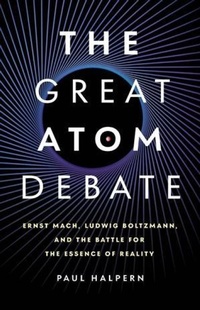
The Great Atom Debate
Ernst Mach, Ludwig Boltzmann, and the Battle for the Essence of Reality
Will be published approx. on 17. December 2026
Book
Hardback
336 pages
978-1-5416-0722-4 (ISBN)
Description
The little-known story of how two of history's greatest physicists waged a war over the existence of the atom and the nature of reality itself
Nearly 2,500 years ago, the Greek philosopher Democritus argued presciently, but without evidence, that all matter is made of tiny indivisible entities called atoms. Other sages, similarly lacking proof, suggested that nature is continuous. By the later nineteenth century, though science progressed, the question of nature's basic ingredients remained elusive. Two extraordinarily brilliant, incredibly stubborn Austrian physicists of that era-Ernst Mach and Ludwig Boltzmann-fought to determine whether flowing energy or discrete matter was the chief component of the universe. Mach treated atoms as useful fictions. Boltzmann, however, insisted atoms were a physical necessity. The titanic struggle rattled Boltzmann's nerves, and he eventually descended into madness and suicide. Extraordinary experiments soon thereafter vindicated his lonely plea for atoms. Despite their differences, both thinkers influenced the young Albert Einstein, paving the way for relativity and quantum theory. Mach is best known today for his groundbreaking work on supersonic speed and shock waves.
By connecting the clash of Boltzmann and Mach to today's debates over what is fundamental, The Great Atom Debate does more than help us understand physics' past. It helps us make sense of the unseen entities that loom over physics' future.
Nearly 2,500 years ago, the Greek philosopher Democritus argued presciently, but without evidence, that all matter is made of tiny indivisible entities called atoms. Other sages, similarly lacking proof, suggested that nature is continuous. By the later nineteenth century, though science progressed, the question of nature's basic ingredients remained elusive. Two extraordinarily brilliant, incredibly stubborn Austrian physicists of that era-Ernst Mach and Ludwig Boltzmann-fought to determine whether flowing energy or discrete matter was the chief component of the universe. Mach treated atoms as useful fictions. Boltzmann, however, insisted atoms were a physical necessity. The titanic struggle rattled Boltzmann's nerves, and he eventually descended into madness and suicide. Extraordinary experiments soon thereafter vindicated his lonely plea for atoms. Despite their differences, both thinkers influenced the young Albert Einstein, paving the way for relativity and quantum theory. Mach is best known today for his groundbreaking work on supersonic speed and shock waves.
By connecting the clash of Boltzmann and Mach to today's debates over what is fundamental, The Great Atom Debate does more than help us understand physics' past. It helps us make sense of the unseen entities that loom over physics' future.
More details
Language
English
Place of publication
United States
Target group
College/higher education
Professional and scholarly
Product notice
Trade binding
Illustrations
15 b/w photos to run in text
Dimensions
Height: 235 mm
Width: 152 mm
ISBN-13
978-1-5416-0722-4 (9781541607224)
Copyright in bibliographic data and cover images is held by Nielsen Book Services Limited or by the publishers or by their respective licensors: all rights reserved.
Schweitzer Classification
Other editions
Additional editions
Paul Halpern
The Great Atom Debate
Ernst Mach, Ludwig Boltzmann, and the Battle for the Essence of Reality
E-Book
approx. 12/2026
Basic Books
€14.99
Not yet available
Person
Paul Halpern is a professor of physics at Saint Joseph's University and the author of nineteen popular science books, including Flashes of Creation, The Quantum Labyrinth, Einstein's Dice and Schroedinger's Cat, Synchronicity, and The Allure of the Multiverse. He is the recipient of a Guggenheim Fellowship and is a fellow of the American Physical Society. He lives near Philadelphia, Pennsylvania.