

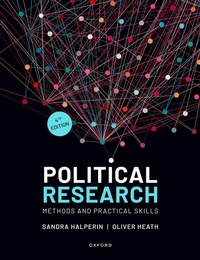
Political Research
Methods and Practical Skills
4th Edition
Published on 15. May 2025
Book
Paperback/Softback
608 pages
978-0-19-284606-8 (ISBN)
Description
The most accessible and practical guide to research methods written especially for politics and international relations students.
Key features
- Discusses step-by-step how to conduct research to support students through the entire research process
- Broad coverage of both quantitative and qualitative methods makes it relevant to any research project
- Discussion of key debates of theory, methodology, and the philosophy of social science to broaden students' knowledge of research methods
- Includes a range of learning features such as chapter summaries and test questions to re-enforce students' understanding of research methods
- Also available as an e-book with functionality, navigation features, and links that offer extra learning support
New to this Edition
- New content on mixed methods in Chapter 6 to highlight the advantages of using different methods or approaches as part of the same study.
- Additional coverage of recent debates and concerns about transparency in research and 'open science', digital data, and analysing social media content.
- Updated examples throughout to cover topical issues in political research, such as the rise of far-right movements and parties, issues relating to immigration and refugees, and the intergenerational transmission of political preferences.
- Now available as an enhanced ebook, featuring video reflections from recent graduates who share their experience of conducting independent research, self-test questions, and flashcard glossaries.
Digital formats and resources
Political Research: Methods and Practical Skills is available for students and institutions to purchase in a variety of formats, and it is supported by online resources.
The following additional resources are available to students:
- Other Students Say videos, where graduate students in Politics and International Relations share their experience conducting research
- Self-test questions at the end of each chapter section allow students to check and consolidate their knowledge
- Flashcard glossaries improve understanding of content
- Example datasets to prompt active engagement and hands-on experience
Adopting lecturers will have access to the following teaching support resources:
- Seminar questions and activities
- Tutorials for data analysis software
- Test bank of questions
- PowerPoint slides
Key features
- Discusses step-by-step how to conduct research to support students through the entire research process
- Broad coverage of both quantitative and qualitative methods makes it relevant to any research project
- Discussion of key debates of theory, methodology, and the philosophy of social science to broaden students' knowledge of research methods
- Includes a range of learning features such as chapter summaries and test questions to re-enforce students' understanding of research methods
- Also available as an e-book with functionality, navigation features, and links that offer extra learning support
New to this Edition
- New content on mixed methods in Chapter 6 to highlight the advantages of using different methods or approaches as part of the same study.
- Additional coverage of recent debates and concerns about transparency in research and 'open science', digital data, and analysing social media content.
- Updated examples throughout to cover topical issues in political research, such as the rise of far-right movements and parties, issues relating to immigration and refugees, and the intergenerational transmission of political preferences.
- Now available as an enhanced ebook, featuring video reflections from recent graduates who share their experience of conducting independent research, self-test questions, and flashcard glossaries.
Digital formats and resources
Political Research: Methods and Practical Skills is available for students and institutions to purchase in a variety of formats, and it is supported by online resources.
The following additional resources are available to students:
- Other Students Say videos, where graduate students in Politics and International Relations share their experience conducting research
- Self-test questions at the end of each chapter section allow students to check and consolidate their knowledge
- Flashcard glossaries improve understanding of content
- Example datasets to prompt active engagement and hands-on experience
Adopting lecturers will have access to the following teaching support resources:
- Seminar questions and activities
- Tutorials for data analysis software
- Test bank of questions
- PowerPoint slides
Reviews / Votes
A comprehensive introductory guide that provides students with theoretical knowledge on the principles of research design and methods alongside significant practical tips to get them started. * Dr Adrian Millican, Durham University *More details
Edition
4th Revised edition
Language
English
Place of publication
Oxford
United Kingdom
Target group
College/higher education
Professional and scholarly
Edition type
Revised edition
Dimensions
Height: 244 mm
Width: 188 mm
Thickness: 26 mm
Weight
1154 gr
ISBN-13
978-0-19-284606-8 (9780192846068)
Copyright in bibliographic data and cover images is held by Nielsen Book Services Limited or by the publishers or by their respective licensors: all rights reserved.
Schweitzer Classification
Other editions
Previous edition
Book
04/2020
3rd Edition
Oxford University Press
€59.41
Article exhausted; check for reprint
Persons
Sandra Halperin, Professor of International Relations, emerita, Royal Holloway, University of London
Oliver Heath, Professor of Politics, Royal Holloway, University of London
Oliver Heath, Professor of Politics, Royal Holloway, University of London
Content
1: Political Research Part I: The Philosophy of Social Science Research 2: Forms of Knowledge in the Study of the Social World 3: Objectivity and Values Part II: How to do Research: An Overview 4: Asking Questions: How to Find and Formulate Research Questions 5: Finding Answers: Theories and How to Apply Them 6: Research Design 7: What is Data? Part III: How to do Research in Practice 8: Experimental Research 9: Comparative Research 10: Historical Research 11: Surveys 12: Interviewing and Focus Groups 13: Ethnography and Participant Observation 14: Textual Analysis 15: Quantitative Analysis: Description and Inference 16: Patterns of Association: Bivariate Analysis 17: A Guide to Multivariate Analysis