


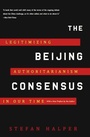
The Beijing Consensus
How China's Authoritarian Model Will Dominate the 21st Century
Published on 6. April 2010
Book
Hardback
312 pages
978-0-465-01361-6 (ISBN)
Description
A leading foreign policy expert tells the story of how China's non-confrontational strategy is reshaping the rules of the new world order. In "The Beijing Consensus", Stefan Halper presents a coherent integration of both the economic and strategic sides of China-US relations. In its efforts to influence the rest of the world-to create a new liberal and democratic order - the United States has used its military and economic might to force developing countries to aim toward democratic reform and transparency. A fine strategy, when you're the only game in town. The Chinese, Halper argues, have chosen to confront the United States only indirectly. Instead of playing by America's rules, as did the Soviet Union, China has redefined the rules of the game. China doles out money to dictators - with no strings attached. They buy resources from Africa and South America - without forcing transparency or reform down oligarchs' throats. In doing so, it's presenting the world's despots with a viable alternative to the so-called Washington Consensus. China is showing the world how to have economic growth with an illiberal government.
At the same time, Halper argues, that its rapid economic growth has created massive fissures in Chinese society between the haves and the have-nots. In order to maintain political control, the Chinese Communist Party has to sustain double-digit economic growth, which means that it must exploit and co-opt the rest of the world's resources. Necessity lies at the heart of China's expansionist policies. Without them, the Communist Party risks its own demise. "The Beijing Consensus" will prove to be a vital book in understanding the increasingly complex relationship between the United States and China-and between China and the rest of the world.
At the same time, Halper argues, that its rapid economic growth has created massive fissures in Chinese society between the haves and the have-nots. In order to maintain political control, the Chinese Communist Party has to sustain double-digit economic growth, which means that it must exploit and co-opt the rest of the world's resources. Necessity lies at the heart of China's expansionist policies. Without them, the Communist Party risks its own demise. "The Beijing Consensus" will prove to be a vital book in understanding the increasingly complex relationship between the United States and China-and between China and the rest of the world.
More details
Other editions
Additional editions
E-Book
02/2012
Basic Books
€8.49
Available for download
Person
Stefan Halper is a Senior Fellow in the Department of Politics and International Studies at the University of Cambridge, where he directs the Donner Atlantic Studies Programme. He is also Senior Research Fellow at Magdalene College, Cambridge, and a Distinguished Fellow at the Nixon Center in Washington, D.C. Halper served in the White House and Department of State during the Nixon, Ford, and Reagan administrations, advising on a range of U.S. foreign policy and national security issues. His writing has appeared in the Washington Post, the Wall Street Journal, the New York Times, and other newspapers and magazines. He is a frequent commentator on national security and foreign policy issues for the print and broadcast media. He divides his time between Great Falls, Virginia, and Cambridge, UK.