

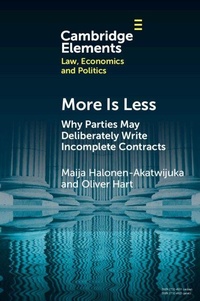
More is Less
Why Parties May Deliberately Write Incomplete Contracts
Published on 23. May 2024
Book
Paperback/Softback
34 pages
978-1-009-39607-3 (ISBN)
Description
Why are contracts incomplete? Transaction costs and bounded rationality cannot be a total explanation since states of the world are often describable, foreseeable, and yet are not mentioned in a contract. Asymmetric information theories also have limitations. We offer an explanation based on 'contracts as reference points'. Including a contingency of the form, 'The buyer will require a good in event E', has a benefit and a cost. The benefit is that if E occurs there is less to argue about; the cost is that the additional reference point provided by the outcome in E can hinder (re)negotiation in states outside E. We show that if parties agree about a reasonable division of surplus, an incomplete contract is strictly superior to a contingent contract. If parties have different views about the division of surplus, an incomplete contract can be superior if including a contingency would lead to divergent reference points.
More details
Series
Language
English
Place of publication
Cambridge
United Kingdom
Product notice
Paperback (trade)
Illustrations
Worked examples or Exercises
Dimensions
Height: 273 mm
Width: 152 mm
Thickness: 5 mm
Weight
70 gr
ISBN-13
978-1-009-39607-3 (9781009396073)
Copyright in bibliographic data and cover images is held by Nielsen Book Services Limited or by the publishers or by their respective licensors: all rights reserved.
Schweitzer Classification
Other editions
Additional editions

Maija Halonen-Akatwijuka | Oliver Hart
More is Less
Why Parties May Deliberately Write Incomplete Contracts
Book
08/2025
Cambridge University Press
Unfortunately, price unknown
The article will not be published
Maija Halonen-Akatwijuka | Oliver Hart
More is Less
Why Parties May Deliberately Write Incomplete Contracts
E-Book
05/2024
Cambridge University Press
€20.99
Available for download
Persons
Content
1. Introduction; 2. The model; 3. Is more less?; 4. Large gains in event; 5. Summary and conclusions; Appendix; References.