

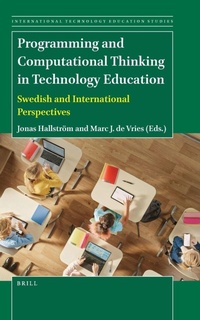
Programming and Computational Thinking in Technology Education
Swedish and International Perspectives
Published on 11. October 2023
Book
Hardback
360 pages
978-90-04-68790-5 (ISBN)
Description
In the last decade, programming and computational thinking (CT) have been introduced on a large scale in school curricula and standards all over the world. In countries such as the UK, a new school subject-computing-was created, whereas in countries such as Sweden, programming was included in existing subjects, notably mathematics and technology education. The introduction of programming and CT in technology education implies a particular relationship between programming and technology. Programming is usually performed with technological artefacts-various types of computers-and it can also be seen as a specific branch of engineering.
This book analyses the background to and current implementation of programming and computational thinking in a Swedish school technology context, in relation to international developments. The various chapters deal with pertinent issues in technology education and its relation to computers and computing, for example, computational thinking and literacy, teachers' programming competence, and computational thinking, programming, and learning in technology education. The book includes examples from educational research that could also be used as inspiration for school teaching, teacher education and curriculum development.
This book analyses the background to and current implementation of programming and computational thinking in a Swedish school technology context, in relation to international developments. The various chapters deal with pertinent issues in technology education and its relation to computers and computing, for example, computational thinking and literacy, teachers' programming competence, and computational thinking, programming, and learning in technology education. The book includes examples from educational research that could also be used as inspiration for school teaching, teacher education and curriculum development.
More details
Series
Language
English
Place of publication
Leiden
Netherlands
Target group
Professional and scholarly
Product notice
sewn/stitched
Cloth over boards
Dimensions
Height: 239 mm
Width: 157 mm
Thickness: 25 mm
Weight
658 gr
ISBN-13
978-90-04-68790-5 (9789004687905)
Copyright in bibliographic data and cover images is held by Nielsen Book Services Limited or by the publishers or by their respective licensors: all rights reserved.
Schweitzer Classification
Other editions
Additional editions
Jonas Hallstroem | Marc J. de Vries
Programming and Computational Thinking in Technology Education
Swedish and International Perspectives
Book
10/2023
Brill
€61.50
Shipment within 10-20 days
Persons
Jonas Hallstroem, Linkoeping University, Sweden, is Professor of Technology Education. His research concerns historical, philosophical, and sociological aspects of technology (education), and his most recent book is Teaching and Learning about Technological Systems (Springer, 2022, co-edited with P. John Williams).
Marc J. de Vries, Delft University of Technology, the Netherlands, is Professor of Philosophy of Technology and Professor of Science and Technology Education. He is the Editor-in-Chief of the International Journal of Technology and Design Education (Springer) and author of, among other publications, the book Teaching about Technology: An Introduction to the Philosophy of Technology for Non-philosophers (Springer, 2016, 2nd edition).
Marc J. de Vries, Delft University of Technology, the Netherlands, is Professor of Philosophy of Technology and Professor of Science and Technology Education. He is the Editor-in-Chief of the International Journal of Technology and Design Education (Springer) and author of, among other publications, the book Teaching about Technology: An Introduction to the Philosophy of Technology for Non-philosophers (Springer, 2016, 2nd edition).
Content
Preface
List of Figures and Tables
Notes on Contributors
1 Introduction: Programming and Computational Thinking in Technology Education
?Jonas Hallstroem
PART 1: Definition, Philosophy and History of Programming and Computational Thinking, in Relation to Technology Education
2 How Computers Entered Swedish Classrooms: The Importance of Educating Digital Citizens
?Joergen Nissen and Linnea Stenliden
3 Transposition of Computing and Programming Knowledge in Swedish Upper Secondary School during the 1970s and 1980s
?Lennart Rolandsson, Cecilia Kilhamn and Kajsa Brating
4 Introducing Programming and Computational Thinking in Grades 1-9: Sweden in an International Context
?Linda Mannila and Fredrik Heintz
5 Design and Make-and Code? Technology Education and a Unified Conception of Technology
?Jonas Hallstroem
6 Framing Computational Thinking and Digital Competence in Technology Education
?Helena Isaksson Persson and Arnold Pears
7 Visual Programming as a Tool for Developing Knowledge in STEM Subjects: A Literature Review
?Karin Stolpe and Jonas Hallstroem
PART 2: Curriculum and Teacher Perspectives on Computational Thinking and Programming in Technology Education
8 Programming in School Technology Education: An Insight into Teachers' Efforts to Unpack and Shape Programming in Technology Education
?Peter Vinnervik
9 Discourses of Programming Teaching within Compulsory Education
?Susanne Engstroem and Eva Bjoerkholm
10 Student Teachers' Experiences of Programmed Technological Artefacts: Range of Understanding and Ideas for Development
?Anna Perez and Maria Svensson
11 Swedish Technology Teachers' Understandings of Computer Programming as Modelling
?Helen Brink
12 Teachers' Experience of Science Centres as a Resource for Programming Education
?Maria Sparf
PART 3: Computational Thinking and Programming in Technology Teaching
13 Introducing Programming in an Early Primary Technology Classroom: The Distinction between Human and Robot
?Astrid Berg and Cecilia Axell
14 Students' Conceptions of Programmed Technological Solutions: A Basis for Organising Teaching
?Anne-Marie Cederqvist
15 Metaphors and Gestures in Programming Education
?Andreas Larsson
16 Product or Process Criteria? What Teachers Value When Assessing Programming
?Lars Bjoerklund and Charlotta Nordloef
Index
List of Figures and Tables
Notes on Contributors
1 Introduction: Programming and Computational Thinking in Technology Education
?Jonas Hallstroem
PART 1: Definition, Philosophy and History of Programming and Computational Thinking, in Relation to Technology Education
2 How Computers Entered Swedish Classrooms: The Importance of Educating Digital Citizens
?Joergen Nissen and Linnea Stenliden
3 Transposition of Computing and Programming Knowledge in Swedish Upper Secondary School during the 1970s and 1980s
?Lennart Rolandsson, Cecilia Kilhamn and Kajsa Brating
4 Introducing Programming and Computational Thinking in Grades 1-9: Sweden in an International Context
?Linda Mannila and Fredrik Heintz
5 Design and Make-and Code? Technology Education and a Unified Conception of Technology
?Jonas Hallstroem
6 Framing Computational Thinking and Digital Competence in Technology Education
?Helena Isaksson Persson and Arnold Pears
7 Visual Programming as a Tool for Developing Knowledge in STEM Subjects: A Literature Review
?Karin Stolpe and Jonas Hallstroem
PART 2: Curriculum and Teacher Perspectives on Computational Thinking and Programming in Technology Education
8 Programming in School Technology Education: An Insight into Teachers' Efforts to Unpack and Shape Programming in Technology Education
?Peter Vinnervik
9 Discourses of Programming Teaching within Compulsory Education
?Susanne Engstroem and Eva Bjoerkholm
10 Student Teachers' Experiences of Programmed Technological Artefacts: Range of Understanding and Ideas for Development
?Anna Perez and Maria Svensson
11 Swedish Technology Teachers' Understandings of Computer Programming as Modelling
?Helen Brink
12 Teachers' Experience of Science Centres as a Resource for Programming Education
?Maria Sparf
PART 3: Computational Thinking and Programming in Technology Teaching
13 Introducing Programming in an Early Primary Technology Classroom: The Distinction between Human and Robot
?Astrid Berg and Cecilia Axell
14 Students' Conceptions of Programmed Technological Solutions: A Basis for Organising Teaching
?Anne-Marie Cederqvist
15 Metaphors and Gestures in Programming Education
?Andreas Larsson
16 Product or Process Criteria? What Teachers Value When Assessing Programming
?Lars Bjoerklund and Charlotta Nordloef
Index